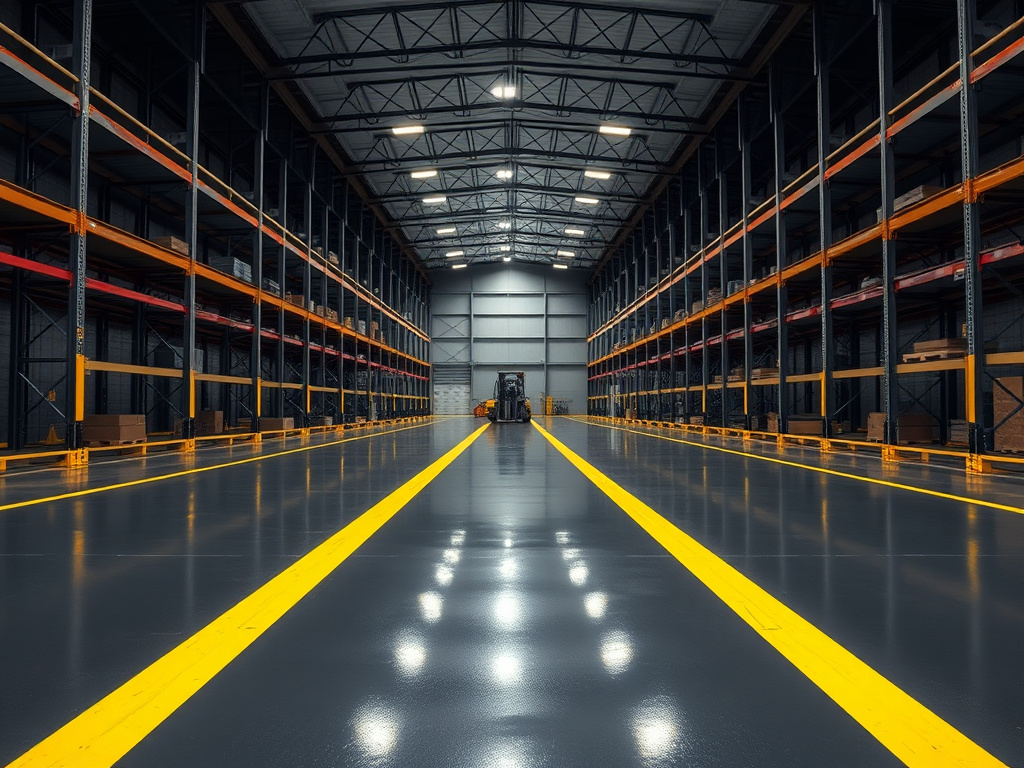
Residential coating decisions are mostly about appearance and heat. Industrial ones are about throughput. A distribution floor in Phoenix or Tucson that has to be shut down for a week of epoxy cure costs the operator far more in lost handling capacity than the entire coating contract is worth, which is why return-to-service time frequently outranks every other property in the specification. Start there, then work backward through traffic class and chemical exposure.
Start with the traffic class
The wheel is the design load. A pallet jack, a cushion-tire forklift and a hard-tire forklift impose radically different point stresses on a floor, and a steel-wheeled cart imposes something different again. Coating manufacturers publish traffic ratings for this reason, and matching the wrong class is the fastest way to a floor that looks worn in eighteen months.
| Light duty — pedestrian, pallet jacks | Offices, pick modules, light assembly. Thin-film polyaspartic at moderate build is adequate. Priority is cleanability, light reflectance and joint control. |
|---|---|
| Medium duty — cushion-tire forklifts | General distribution and staging. High-build polyurea or a polyurea base with a heavy polyaspartic wear coat. Aggregate broadcast for traction in dock areas. |
| Heavy duty — hard-tire and steel-wheel traffic | Manufacturing aisles, die storage, battery rooms. Heavy-build sprayed polyurea or a urethane mortar. Impact resistance and joint edge protection dominate the specification. |
| Chemical / thermal exposure | Plating, food processing, battery charging, hot washdown. Chemistry is selected against the specific exposure list, and thermal shock resistance becomes a governing property. |
Typical system selection by traffic class. Real specifications also account for slab condition, existing joint layout and chemical exposure.
One nuance operators often miss: traffic is not uniform across the building. The main aisle in a Mesa or Chandler distribution center may see thousands of forklift passes a day while the racking bays see almost none. Specifying the heavy-duty system building-wide is expensive; specifying the light system building-wide is a false economy. Zoning the floor by actual traffic pattern is usually the right answer.
High-build systems and why mils matter more than coats
The property that determines how long an industrial floor lasts is total dry film thickness combined with the toughness of the polymer. A thin, hard film wears through at the wheel path; a thick, elastomeric one absorbs impact and abrasion and keeps going.
Sprayed plural-component polyurea is the workhorse here because it can be laid down at substantial mil thickness in a single pass, gels in seconds, and produces a seamless monolithic membrane with high elongation and excellent tear resistance. Where chemical or thermal exposure is severe, a urethane mortar system at even heavier build takes over. In either case, ask for the specification in mils and coats, not in coats alone — three thin coats can total less film than two heavy ones.
Joints are where industrial floors actually fail
Walk any twenty-year-old warehouse and the damage is concentrated in two places: the dock approach and the control joints. Joint edges spall under repeated hard-wheel impact, the spall widens, and eventually you have a trench that damages wheels and rattles loads.
Correct joint treatment is a separate scope from coating and it is not optional on a trafficked floor. It means routing out damaged joint edges, rebuilding them with a semi-rigid filler that supports the edge under load rather than a flexible sealant that lets it flex, and matching the fill to whether the joint is still moving. Coating over an untreated joint hides the problem until the first pallet jack finds it. The grinding and repair side of this is described on our concrete preparation and repair page.
Chemical exposure: specify against the actual list
“Chemical resistant” is not a specification. Resistance is always against particular substances at particular concentrations for particular contact durations. A coating that shrugs off diesel may be attacked by a strong caustic cleaner. One that handles sulfuric acid in a battery room may soften under a hot food-processing washdown.
The right process is to hand the applicator a written exposure list — what is stored, what is spilled, what the floor is cleaned with, at what temperature — and let the product selection follow from it. That same discipline drives every warehouse and industrial floor we spec, and it becomes even more rigorous on containment work where the lining is the last barrier between a product and the ground.
Thermal shock deserves its own mention. A floor washed with 180°F water and then hit with ambient air experiences rapid differential expansion between coating and slab. Rigid systems debond under that cycle; elastomeric ones with high elongation tolerate it. If your facility does hot washdowns, say so before anyone quotes.
Phased installs and the return-to-service math
Here is where fast-cure chemistry earns its price. Run the numbers on any operating facility and the arithmetic is stark: an epoxy system that needs five to seven days before vehicles can run on it takes a bay out of service for a full week. A polyurea or polyaspartic system in the same bay is back under forklift traffic the next shift.
That difference makes genuinely phased work possible. We routinely install a 100,000 square foot floor bay by bay, coat a dock apron between the last outbound truck and the first inbound one, or take a production aisle over a weekend shutdown and hand it back Monday morning. Practical sequencing on an Arizona facility usually looks like this:
- ✓Zone the building by traffic class and by what can be emptied at the same time
- ✓Test and profile ahead of coating day so the install window is pure production
- ✓Shot blast rather than grind on large open areas — faster production rate and a deeper CSP profile
- ✓Treat joints and repair spalls in the same shift, with cure times that fit the window
- ✓Spray the high-build coat, then return to service the following shift rather than the following week
- ✓Stripe, number and mark aisles last so the layout can change without recoating the floor
Night and weekend work is normal for us on facility jobs across Phoenix, Mesa, Gilbert, Scottsdale and Tucson, and we run crews to Flagstaff and Prescott for high-country plants where freeze-thaw at the dock doors adds another design constraint. The regional split is explained on our service areas page.
What to put in the bid request
If you are soliciting quotes, giving every bidder the same information is the only way to compare them. Include square footage by zone, traffic type and daily volume, the chemical exposure list, cleaning method and temperature, existing floor condition and any prior coating, joint layout and condition, available shutdown windows, and whether a moisture test has been done. Bids built from that will differ by approach rather than by guesswork.
The same materials logic that governs a garage governs a warehouse — it is just weighted differently. If you want the underlying chemistry explained, the polyurea vs epoxy vs polyaspartic guide covers glass transition, elongation and cure schedules in detail, and the prep and failure-mode piece explains why a profile spec belongs in every bid. When you are ready to scope a building, start here.