Free scoped estimate · Arizona statewide
Get a Free Coating Quote
Tell us what the space is, what shape the slab is in and what you want it to look like when it is finished. You get a written, itemized number — prep, repair, build and topcoat broken out separately — not a single mystery figure.
Same Day
Typical response
Free
On-site scoping
Itemized
Line-by-line pricing
Statewide
Every AZ county
How a coating is actually priced
Six variables decide your number, and square footage is only one of them
We are not going to publish a dollar figure on this page, because any number printed without seeing your concrete is marketing, not an estimate. What we can do is tell you exactly what the estimator is looking at when the number gets built, so you can read our quote — or anyone else's — with real judgement.
Square footage sets the floor, not the price. Material and labor scale with area, so a 400 sq ft one-car garage and a 12,000 sq ft distribution bay start in very different places. But the per-square-foot rate moves in the opposite direction as the job grows: mobilization, equipment setup and crew time are largely fixed, so small jobs carry a higher rate per foot and very large floors carry a lower one. If a bid quotes you the same rate for a garage and a warehouse, someone is not thinking about it carefully.
Slab condition is the single biggest swing factor. Sound, clean, uncoated concrete is the cheapest surface in the world to work on. Concrete with map cracking, spalled edges, blown control joints, oil saturation, an old sealer, or a failing coating on top of it is a different job entirely — and the repair work is real construction, not a line you can wave away. This is why we grind first and confirm repair scope second: grinding is what reveals the true condition, and no honest estimator pretends to know it beforehand.
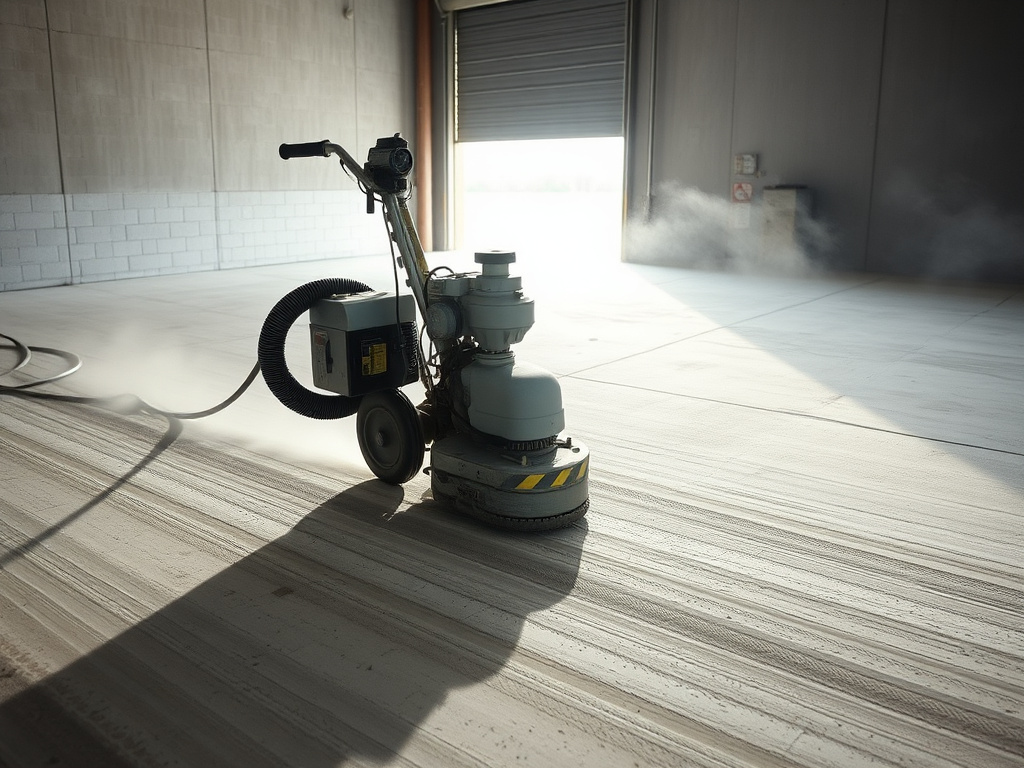
Prep scope follows from that condition. Diamond grinding to a CSP 2–3 profile is the baseline on every job we do. Shot blasting costs more and is specified when the surface is heavily contaminated or when a high-build industrial system needs a deeper profile. Removing a failed epoxy adds a full mechanical pass. And if moisture testing comes back high — which happens more often in Tucson and along the southern corridor than most homeowners expect — a vapor-mitigating primer becomes part of the specification. Skipping that step is how a floor peels in eighteen months.
Finish system changes both material and labor. A solid-color industrial build, a full-chip flake broadcast to refusal, a quartz aggregate system tuned for a pool deck, and a metallic pour are four different amounts of product and four different amounts of hand work. Traction level matters too: a slip-resistant broadcast on a wet-service kitchen floor is a heavier, more labor-intensive build than a smooth garage. And any exterior surface gets an aliphatic topcoat, no exceptions, because an aromatic product in Arizona sun chalks and shifts color within a couple of seasons.
Access and logistics are quietly expensive. A rig that can park twenty feet from the slab is cheap. A third-floor parking structure, a containment berm behind a locked process area, a roof deck with no hoist, or a site four hours from the Valley on a dedicated route day all add real cost before a single square foot is ground. So does anything that limits how much of the floor we can open at once.
Downtime constraints are the last variable. Polyurea returns to service in hours, which is precisely why it is worth paying for on a commercial floor — but night shifts, weekend windows and phased bay-by-bay sequencing all cost more than a straight daytime install. That uplift is almost always smaller than the cost of the lost production it protects, and we will say so plainly in the quote rather than burying it.
Have this ready before the call
None of it is required — the form works fine without it — but every item here tightens the estimate and shortens the time between your request and a firm number.
- ✓Measured length and width, not a car count
- ✓Photos of the worst areas, including cracks and stains
- ✓Roughly how old the slab is and whether it was ever coated or sealed
- ✓Whether anything is currently peeling, chalking or lifting
- ✓Floor drains, expansion joints, cove base and threshold details
- ✓Chemicals, hot tires, forklifts or wash-down the floor has to survive
- ✓Any hard scheduling window — shutdown dates, move-in dates, events
- ✓The finish direction you are leaning toward, even loosely
Reading a bid
What a suspiciously cheap quote is leaving out
Coating is one of the easiest trades in which to hide a shortcut, because the two things that decide whether a floor lasts — surface profile and film thickness — are both invisible the day the job is finished. A floor that was acid-etched instead of ground and shot at half the specified mils looks identical to a correctly built one for roughly a year.
So compare bids on the line items, not the bottom line. Ask what the prep method is and refuse anything that says etching. Ask for the dry film thickness the system is built to. Ask whether the topcoat is aliphatic or aromatic if any part of the surface sees sun. Ask what the warranty actually covers and what it excludes. Any applicator who cannot answer those four questions on the spot is not the applicator you want.
Is the quote actually free, and is there any obligation?
+
Yes, and no. Scoping a floor costs us time, not money, and we would rather spend an hour measuring a slab than argue about a change order later. You get a written, itemized number covering prep, repair, base build, broadcast and topcoat. If the number does not work for you, or if we tell you polyurea is the wrong material for your slab, that is the end of it. Nothing is owed and nobody follows up forever.
Why won't you quote a firm price over the phone?
+
We will give you a per-square-foot range on the phone in about two minutes. What we will not do is commit to a firm number before anyone has seen the concrete, because prep is the majority of the labor and prep scope is invisible from a description. A slab that sounds fine can turn out to be sealed, pushing moisture vapor, or carrying a failed coating under a layer of dust. Quoting that blind produces either a padded number or a change order, and both are worse for you.
How fast can you get on my calendar?
+
Residential garages in the Phoenix metro typically schedule within one to two weeks of an accepted quote, and the install itself is a single day. Tucson, Flagstaff, Prescott and Yuma run on route days, so timing depends on when we are next in the corridor — usually two to three weeks. Commercial and industrial work is scheduled around your production window, including nights, weekends and phased bays, and that scheduling conversation happens before the number is finalized.
What information makes my quote more accurate?
+
Four things move it the most: real measured dimensions rather than a car-count estimate, honest photos of the worst areas rather than the best, the age and history of the slab, and any constraint on when we can be there. If a previous coating is peeling, say so — that is a removal line item, not a surprise. If the space has floor drains, expansion joints, chemical exposure or a hard shutdown limit, those change the specification and the price more than square footage does.
Where we work
Yes, we quote outside the Valley
Phoenix, Mesa, Scottsdale, Chandler and Gilbert are our densest routes, and most weeks we are somewhere in that grid every day. But the whole state is fair game: Tucson and the southern corridor, Flagstaff and Prescott in the high country, Yuma, Casa Grande and the mining communities in between.
Distance affects scheduling more than it affects price. Out-of-metro work is grouped onto route days so mobilization is shared across several jobs, which is why a Flagstaff garage might wait an extra week but does not carry an absurd travel surcharge. Tell us the city on the form and we will tell you honestly when we can be there.