27 questions · answered straight
Polyurea & Polyaspartic Coating FAQs
Including the skeptical questions. Polyurea is an excellent material with real limitations, and you are better served knowing both before you spend money on it.
Most coating FAQ pages are sales copy wearing a question mark. This one is not. Every question below came out of what Arizona homeowners and facility managers actually type into a search bar, which means roughly a third of them are hostile: what are the negatives, what are the dangers, what does it not stick to, can I do this myself. Those get real answers here, not deflections.
The short version, if you only read one paragraph: polyurea and its polyaspartic derivative are the correct material for most Arizona concrete because they stay flexible through extreme slab temperatures, hold color under ultraviolet light and return to service in hours. They also cost more than epoxy, cannot be installed without heated plural-component equipment and a trained crew, and will fail as fast as anything else if the concrete underneath them was not properly prepared. Both halves of that are true.
Jump to a section
- Material & chemistry6
- Cost & value4
- Installation & timeline4
- Durability & Arizona conditions5
- Residential specifics4
- Commercial & industrial4
Not finding it? Call 844-967-5247 and ask directly.
Call 844-967-5247Group 01
Material & chemistry
What polyurea actually is, how it differs from polyaspartic, and the honest limits of the material — including what it refuses to stick to.
What is a polyurea coating?
+
Polyurea is an elastomeric polymer formed when an isocyanate component reacts with an amine-terminated resin blend. The reaction is extremely fast and does not need a catalyst, solvent or heat cure — the two parts meet at the spray gun tip and the film is gelled within seconds. The result is a seamless, flexible, chemically resistant membrane rather than a rigid plastic shell. On concrete it is used as a floor system, a waterproofing membrane, a containment lining and a spray-in truck bed liner, all from the same chemistry family with different formulations.
What is the difference between polyurea and polyaspartic?
+
Polyaspartic is a subclass of polyurea, not a competing material. It is made with an aspartic ester resin instead of a standard amine, which slows the reaction from seconds to a workable pot life of roughly twenty to forty minutes. That controllability is why polyaspartic is almost always the topcoat and pure polyurea is the basecoat or the high-build lining. Polyaspartics are also aliphatic, meaning they hold their color under ultraviolet light, which is exactly why they finish every exterior surface we install in Arizona.
What are the negatives of polyurea?
+
It costs more than epoxy per square foot, sometimes considerably. Its cure speed leaves almost no margin for error — a mistake in the film cannot be brushed out thirty seconds later. It demands heated, plural-component spray equipment and a trained applicator, so the installer matters more than the product. Aromatic polyurea formulations chalk and shift color badly under direct sun unless finished with an aliphatic topcoat. And it will not bond to a poorly prepared surface, so a bad prep job wastes an expensive material.
What are the dangers of polyurea?
+
During application, the isocyanate side is a respiratory sensitizer, and the spray operation produces aerosol that requires supplied-air respirators, protective suits and controlled ventilation. That is a genuine occupational hazard and the main reason this is professional-only work. Once the coating has fully reacted and cured, it is inert: no ongoing off-gassing, no solvent smell, safe for pets, food-service floors and living spaces. The risk window is the install itself, which is why we set containment and control site access while the rig is running.
What does polyurea not stick to?
+
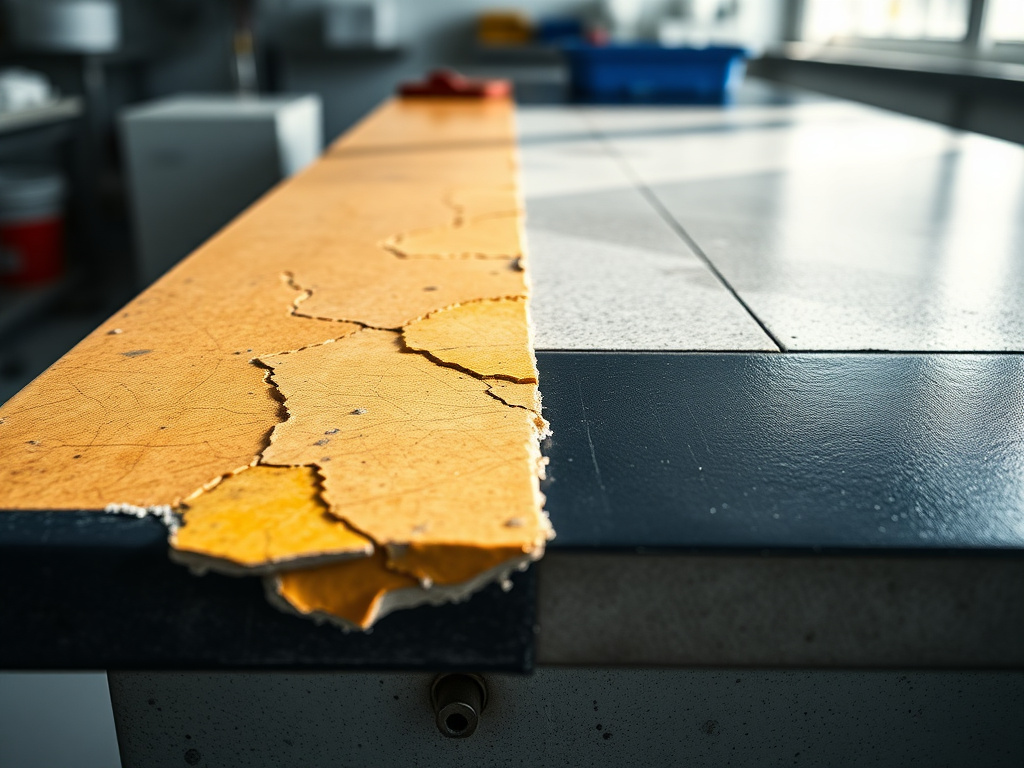
Silicone, most polyolefin plastics such as polyethylene and polypropylene, PTFE, and anything with a release agent or mold-release residue on it. It also will not bond to oil-saturated concrete, an intact sealer, loose laitance, a chalking existing coating, or a slab actively pushing moisture vapor from below. Almost all real-world adhesion failures are surface problems rather than material problems — the coating bonded perfectly to a contaminated layer that was never bonded to the concrete underneath it.
Can I apply polyurea myself?
+
Honestly, no — not true polyurea. It requires a plural-component proportioner that heats both components to roughly 150°F, holds them at 2,000 psi or more, and meters them at a precise ratio through an impingement-mix gun. That equipment is a serious capital investment and takes real training to run. Gel time is measured in seconds, so there is no opportunity to correct a run or a holiday. The consumer products sold as polyurea in big-box stores are typically thin single-component hybrids and are not the same material.
Group 02
Cost & value
Why we scope before we price, what genuinely drives the number, and how to read the bid that came in thousands under everyone else.
How much does a polyurea garage floor cost in Arizona?
+
We will not print a figure here, because any number published without seeing your concrete is advertising rather than an estimate. What we will tell you is what moves it: measured square footage, the true condition of the slab once it is ground, how much crack and spall repair is required, whether moisture mitigation is needed, which finish system you choose, and access. Call and we will give you a per-square-foot range on the spot, then a firm itemized number after the site visit.
Why is polyurea more expensive than epoxy?
+
Three reasons, all structural. The raw materials cost more per gallon. The equipment is a heated plural-component rig rather than a bucket and a squeegee, and that capital and maintenance sit in every job. And the labor is skilled — a fast-gelling material rewards an experienced applicator and punishes an inexperienced one, so the crew rate is higher. What you are buying for the difference is service life and return-to-service speed, which is a very different value calculation on a commercial floor than on a spare-room slab.
Is polyaspartic worth the money?
+
For an Arizona floor that sees sun, heat or vehicles, generally yes — and the honest way to evaluate it is cost per year of service rather than cost at install. A correctly built polyaspartic system that runs fifteen years without recoating usually beats a cheaper epoxy that ambers in three and delaminates in five, once you count the second and third installs plus the disruption. For a shaded interior storage room with light foot traffic and no UV exposure, that math genuinely does not favor it.
Why is one bid so much cheaper than the others?
+
Almost always because of prep method or film thickness, and both are invisible on the day the job finishes. A floor that was acid-etched instead of diamond-ground, or shot at half the specified mils, looks identical to a correctly built one for roughly a year. Ask every bidder four questions: what is the prep method, what is the dry film thickness, is the topcoat aliphatic or aromatic, and what exactly does the warranty exclude. The cheap bid usually falls apart on the first two.
Group 03
Installation & timeline
What a one-day install really involves, why we never acid-etch, and how summer heat changes the schedule rather than cancelling it.
Can a garage floor really be finished in one day?
+
For most residential garages, yes. Grinding and vacuum runs through the morning, then crack chase and patch, then the base application, then flake broadcast to refusal, then a scrape and vacuum before the polyaspartic topcoat in the afternoon. Foot traffic is usually fine that evening and vehicles the next day. What breaks the single-day schedule is discovering serious slab problems: heavy moisture, extensive spall repair, or a failed coating that has to be fully removed. Those become two-day jobs and we tell you before we start.
Do you grind the concrete or acid-etch it?
+
We diamond grind, without exception, to a CSP 2–3 profile, or shot blast for heavier industrial builds. Acid etching is the single most common cause of coating failure on residential floors: it leaves an inconsistent profile, it can drive salts into the surface, and neutralizing it properly is rarely done well in the field. If a bidder tells you etching is equivalent to mechanical profiling, that is the moment to end the conversation, whatever the price is.
Can you coat over my existing epoxy floor?
+
Sometimes, and only after testing. If the existing coating is well bonded, passes an adhesion pull test and can be mechanically abraded to a sound profile, recoating is legitimate and saves you removal cost. If it is delaminating, blushing, chalking, or was installed over an acid-etched slab, it has to come off entirely — otherwise your new system is only as strong as the failed layer holding it up. We test rather than guess, and we tell you which situation you are in.
Is it too hot to install a coating in an Arizona summer?
+
No, but it changes how we work. Slab temperature drives cure speed, so a 130°F garage floor at 2 p.m. shortens working time to a point where quality suffers. We start early, work shaded or interior spaces during peak heat, monitor slab temperature rather than air temperature, and watch dew point in monsoon season because applying over a slab below dew point traps moisture at the bond line. Summer installs are routine here; they are just scheduled around physics instead of convenience.
Group 04
Durability & Arizona conditions
Service life, UV color hold, hot-tire pickup, high-country freeze-thaw, and the five failure modes that account for nearly every failed floor.
How long does a polyurea floor last in Arizona?
+
A properly prepped residential garage system typically runs fifteen to twenty years before it needs anything beyond cleaning. Heavy industrial floors with forklift traffic and chemical exposure are more realistically ten-plus years, and high-wear lanes may want a recoat before the rest of the floor does. Those numbers assume real mechanical prep and full specified thickness. Failures at year two are essentially never chemistry failures — they trace back to etching, moisture, contamination or a thin single-coat install.
Will it fade or turn yellow in the Arizona sun?
+
Not if the topcoat is aliphatic. Aromatic polyureas and standard epoxies contain benzene ring structures that break down under ultraviolet light, which produces the familiar ambering and surface chalking. Aliphatic polyaspartics do not have that vulnerability and hold color for many years of direct exposure. This is the single most important question to ask any bidder quoting an exterior patio, pool deck or driveway in this state, and a surprising number of low bids quietly use an aromatic product outdoors.
Will it lift when I park a hot car on it?
+
Hot-tire pickup happens when a tire hot from summer pavement softens a coating with a low glass transition temperature and pulls it away from a weakly bonded surface. It needs both conditions to occur. Polyurea and polyaspartic systems have far higher heat tolerance than epoxy, and when they are installed over a properly ground profile, the bond to the concrete is stronger than the tire. Hot-tire lift on a correctly built polyurea floor is rare, and when it happens the root cause is prep.
What about freeze-thaw in Flagstaff and Prescott?
+
Above about five thousand feet the design problem inverts completely. Instead of heat and UV, the enemies are water entering the slab, freezing, expanding, and de-icing salt attacking the concrete and the bond line. The answer is a flexible, low-permeability system with a primer strategy chosen for a colder, wetter substrate, and careful attention to edges and joints where water gets in. Same material family, genuinely different specification — a bid that does not change with elevation is a bid worth questioning.
What are the common problems with concrete coatings?
+
In rough order of frequency: inadequate surface preparation, moisture vapor drive from an unsealed or high-water-table slab, applying over an existing sealer or contaminant, insufficient film thickness, and using a UV-unstable product outdoors. Notice that four of the five are workmanship or specification decisions rather than material defects. The other real one is unrealistic expectations about cracks — a coating bridges hairlines and moves with minor slab movement, but it cannot stop a structurally active crack from telegraphing through eventually.
Group 05
Residential specifics
Garages, pool decks, patios and driveways — plus cracked slabs and the two-line maintenance routine that keeps a floor looking new.
What is the best coating for a garage floor in Arizona?
+
A polyurea basecoat with a full broadcast of decorative flake and an aliphatic polyaspartic topcoat, over a diamond-ground slab. That combination gives you heat tolerance well past what a Phoenix garage reaches in August, flexibility over slab movement, a texture that hides dust and tire marks, and a color that does not amber. Single-coat products, big-box kits and thin two-coat epoxies all fail in this climate for predictable reasons, and most of our residential work is the second coating on a floor.
What is the best material for a pool deck in Arizona?
+
For an existing concrete deck, a textured polyaspartic system with a light-colored aggregate broadcast is usually the strongest option: it is barefoot-tolerant because the light color reflects heat, it is genuinely slip-resistant when wet, it is seamless so there are no joints to trap algae, and it holds color under constant UV. Pavers and travertine are beautiful and stay cool, but they cost more and have joints. Traditional acrylic cool-deck is cheaper and does chip, crack and require refinishing sooner.
My slab has cracks — do I need to replace the concrete?
+
Usually not. Hairline shrinkage cracks and most map cracking are cosmetic and get chased out to a V, filled with a polyurea repair compound, and ground flush before coating. What a coating cannot fix is a structurally active crack caused by settlement, heaving or a failed subgrade — that will move again and eventually telegraph through any membrane. We tell you honestly which kind you have during the site visit, because coating over a structural problem just delays it.
How do I clean and maintain a polyurea floor?
+
Dust mop or blow it out, then damp mop with a pH-neutral cleaner. Avoid anything with citrus, ammonia, bleach or a degreaser strong enough to dull the finish, and skip so-called mop-and-shine products entirely — they leave a film that is harder to remove than the dirt was. Do not leave rubber mats or tires parked on the same spot indefinitely on a hot floor, because plasticizer from the rubber can migrate and stain. That is genuinely the entire maintenance program.
Group 06
Commercial & industrial
Warehouse specifications, phased night work, submittal support, containment linings, and exactly what the warranty does and does not address.
What is the best floor finish for a warehouse?
+
It depends almost entirely on the traffic and the exposure. For general distribution with pallet jacks and forklifts, a high-build polyurea with a broadcast for traction is a strong default. For food service and wash-down environments, a urethane mortar or polyurea system with integral cove base and a slip-rated surface is usually the right call. For a purely dry storage bay with foot traffic, a densified and polished slab may be more sensible than any coating at all — and we will say so.
Can you work nights or weekends so we do not shut down?
+
Yes, and this is the main reason facilities accept the higher polyurea cost. Because the material returns to service in hours rather than days, an area can be closed Friday evening and released Monday morning, or a distribution floor can be phased bay by bay across several nights with production continuing beside it. We build the phasing plan with your operations lead before the number is finalized, since crew size and sequencing are what make an aggressive window achievable.
Do you provide submittals and specification support?
+
Yes. Product data sheets, safety data sheets, system build-up details, adhesion pull-test results and dry film thickness reports are all standard on request for general contractors, architects and facility engineers. If you send us a written specification we will read the actual section and tell you plainly whether the specified system suits the substrate and the exposure, and flag anything likely to cause a field problem in an Arizona building before it becomes a change order rather than after.
What does your warranty actually cover, and what does it exclude?
+
The warranty addresses the things within our control: adhesion failure, delamination, peeling, hot-tire lift and ultraviolet color hold on the aliphatic topcoat. It does not address structural movement in the concrete, damage from impact or from chemicals outside the specified exposure, failure caused by cleaning with products we advise against, or moisture originating below a slab that the owner declined to have mitigated after testing flagged it. Those exclusions are written plainly in the document rather than buried in it.
Go deeper
Where each of these answers gets a full page
Polyurea vs epoxy
The full comparison — chemistry, heat, UV, cost and the cases where epoxy still wins.
Read more →Garage floor coatings
Flake systems, finish options and the one-day residential install timeline.
Read more →Concrete prep & repair
Diamond grinding, shot blasting, moisture testing and crack repair — the half nobody sees.
Read more →Arizona service areas
Why a Flagstaff specification is not a Phoenix specification, city by city.
Read more →Still have a question that is not here? Send it over or request a free quote and ask the estimator directly on the call.
Still deciding? Get a real number first.
A scoped, itemized estimate costs nothing and answers the one question this page cannot: what your specific slab will take.