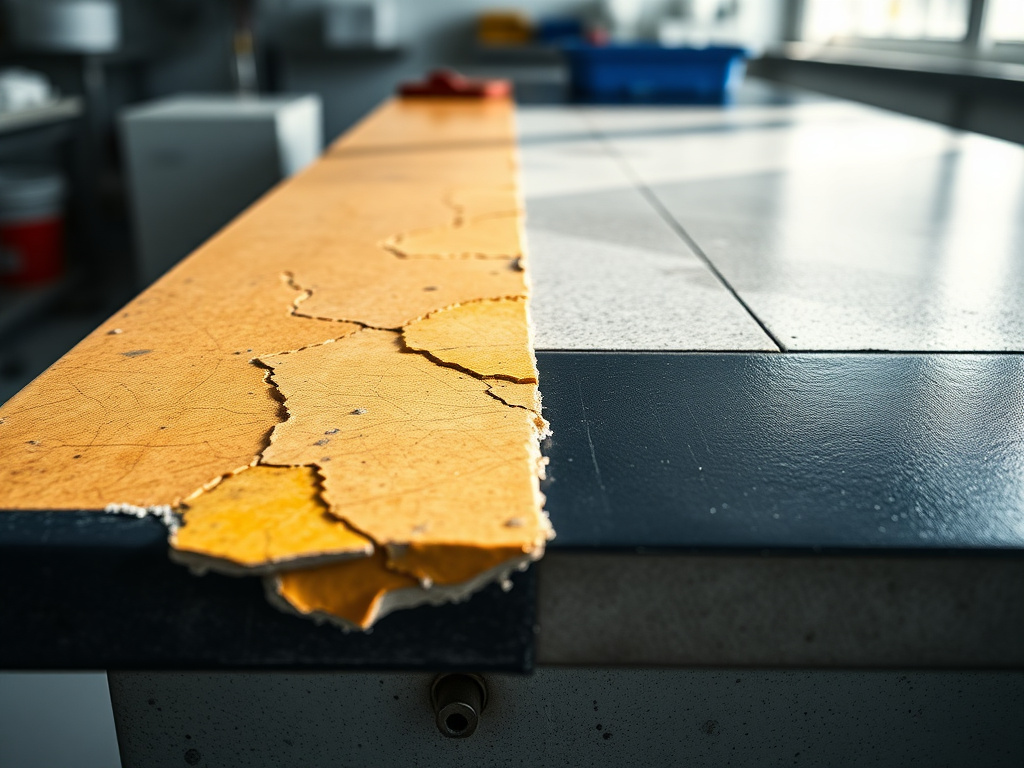
Nearly every Arizona homeowner who calls us about a garage floor has already had one coated. Sometimes it was a weekend kit from a big-box store. Sometimes it was a licensed crew with a good-looking sample board. Either way, the call sounds the same: it looked great for a year or two, then a patch came up under the driver’s side tire, the color went from grey to a strange yellow-tan near the door, and now it is flaking at the control joints. That is not bad luck and it usually is not bad workmanship in the painting sense. It is a materials mismatch, and it is predictable enough that you can diagnose it from a photo.
The three chemistries that get sold as “garage floor coating” in Phoenix, Mesa, Chandler, Gilbert and Scottsdale are epoxy, polyurea, and polyaspartic. They are not competing brands of the same product. They are structurally different polymers with different backbones, different cure mechanisms, different mechanical properties, and very different tolerance for the thing Arizona does best: heat. What follows is the comparison we wish every homeowner had before they signed the first bid.
Three materials, three genuinely different jobs
Start by discarding the idea that one of these is simply “better.” Each one exists because it solves a problem the others do not. Epoxy is a rigid, high-build, inexpensive thermoset that bonds tenaciously to profiled concrete and can be laid thick in a single pass. Polyurea is an elastomer — it behaves more like a tough rubber membrane than a plastic shell, it cures in seconds, and it can be sprayed vertically without sagging. Polyaspartic is a chemically modified polyurea engineered to slow that reaction down enough to be applied by hand while staying color-stable in ultraviolet light.
The system we install on a typical Arizona garage uses two of the three deliberately: a polyurea or polyaspartic base coat that penetrates and grips the freshly ground slab, a broadcast of decorative vinyl flake or quartz to refusal, and an aliphatic polyaspartic topcoat that carries the wear, the gloss, the traction and the UV resistance. Epoxy can legitimately serve as the base coat in some interior specifications. It should almost never be the top layer on a floor that sees Arizona sun.
The chemistry, without the marketing
Epoxy
Epoxy cures when an epoxide resin reacts with an amine or amide hardener. The result is a densely crosslinked thermoset — hard, dimensionally stable, chemically resistant, and rigid. Rigidity is the whole story. Epoxy has an elongation at break in the neighborhood of two to five percent, meaning it can stretch almost not at all before it fractures. Concrete, meanwhile, never stops moving. It shrinks as it continues to cure for years, it expands and contracts with a thirty-degree daily temperature swing, and it opens control joints as it does so. A rigid film over a moving substrate is a crack waiting for a location.
Polyurea
Polyurea forms when an isocyanate reacts with an amine-terminated resin. That reaction is extraordinarily fast — gel times of five to thirty seconds are normal — and it is insensitive to moisture and temperature during cure, which is why polyurea can be sprayed in humidity and cold that would ruin an epoxy. The resulting polymer is an elastomer with 300 to 400 percent elongation and excellent tear and abrasion resistance. The trade-off is that it is not a hand-applied material: it requires heated, high-pressure plural-component spray equipment with impingement mixing, which is precisely why you have never seen it in a hardware store.
Polyaspartic
Polyaspartic chemistry replaces the fast amine with a sterically hindered polyaspartic ester and pairs it with an aliphatic isocyanate. Two things change. First, the reaction slows dramatically — pot life becomes twenty to ninety minutes and is tunable with retarders, so a crew can roll or squeegee it. Second, because the isocyanate is aliphatic rather than aromatic, the polymer has no UV-labile aromatic ring in the backbone to break down under sunlight. It does not amber. That single property is why polyaspartic is the standard topcoat on every exterior-adjacent floor we install, from a Scottsdale garage with a west-facing door to a Chandler pool deck.
Glass transition temperature: the number that decides an Arizona floor
If you learn one piece of polymer science before buying a garage floor, make it this one. Every polymer has a glass transition temperature, written Tg. Below Tg the material is glassy, hard, and dimensionally stable. Above Tg it becomes rubbery — softer, tackier, and dramatically weaker in surface hardness. Tg is not a melting point; nothing dramatic appears to happen. The film just quietly gets soft.
Common floor epoxies have a Tg somewhere in the range of 105 to 140°F. Now consider what an Arizona garage slab actually does. Ambient air at 115°F, a slab with the door open to direct afternoon sun, radiant load off the driveway, and no ventilation. Slab surface temperatures of 130 to 145°F in an attached Phoenix garage are ordinary in July. That means an epoxy floor here spends a significant part of every summer afternoon operating at or above its glass transition point. It is soft precisely when the hottest tires in the state are about to be parked on it.
Polyurea and polyaspartic systems are formulated with service ranges that comfortably span roughly −30°F to 250°F. The film in a Tucson garage in August is doing the same thing mechanically that it does in a Flagstaff garage in February. That thermal margin is the single most important reason we specify these materials statewide, and it is the reason the same product line works in both the low desert and the high country with only a primer and film-build change.
Hot-tire pickup is a bond failure, not a stain
Homeowners describe hot-tire pickup as the coating “melting” or the tire “burning” the floor. Neither is what happens. Here is the actual mechanism, step by step.
- A tire returning from I-10 or the 101 is carrying heat from both friction and the road surface. Tread temperatures of 150 to 180°F are unremarkable in an Arizona summer.
- Warm rubber releases plasticizers and process oils. Those migrate to the tire surface and act as a mild solvent on an organic coating film.
- If the coating is already above its Tg, its surface is soft enough for those plasticizers to penetrate and for genuine adhesion to develop between rubber and film.
- The car sits. The tire cools and contracts. The rubber shrinks harder than the coating can resist, and it peels a patch of film off the concrete — usually an oval about the size of the contact patch, with clean grey concrete underneath.
Read that last line again: clean concrete underneath. If the failure surface is bare grey concrete with no coating residue, the film never had a proper mechanical bond to begin with, which points at the prep. If the failure leaves a thin layer of coating still stuck to the slab, the film split within itself, which points at the material. Most Arizona epoxy failures we tear out show clean concrete — a prep problem and a materials problem stacked on top of each other. That is the subject of a separate piece on why garage floor coatings peel here.
Elongation, crack bridging, and a slab that never stops moving
A 20-by-22-foot two-car garage slab in Mesa will move measurably every single day. Sun hits the driveway apron, the slab edge warms and expands, the interior stays cooler, and the whole plate flexes a fraction of a millimeter. Over a year, seasonal shrinkage adds hairline cracks. Over five years, a control joint that started at an eighth of an inch may open to three-sixteenths.
An epoxy film with two to five percent elongation cannot absorb that. It telegraphs every hairline directly through to the surface and then fractures along it, and once the film is fractured, water and dust get under it and the delamination spreads outward from the crack. An elastomeric polyurea at 300 to 400 percent elongation simply stretches over the movement. A polyaspartic topcoat at 100 to 200 percent does the same at a smaller magnitude. This is also why we treat cracks and joints as a separate line item during concrete preparation and repair rather than pretending the topcoat will hide them.
UV, aromatic vs aliphatic, and the yellow floor problem
When a customer says their floor “turned yellow,” they are describing ambering — photo-oxidative degradation of an aromatic polymer backbone. Aromatic isocyanates and epoxide resins both contain benzene rings. Ultraviolet photons have enough energy to break bonds adjacent to those rings, forming quinoid structures that absorb blue light and reflect yellow. It starts within weeks of sun exposure and it is irreversible. Worse, the same reaction embrittles the surface, so an ambered floor is also a chalking, easily-scratched floor.
Aliphatic chemistry has no aromatic ring to attack. That is the entire technical basis for the phrase “UV stable,” and it is the one specification that matters most in a state that gets over three hundred sunny days a year. Ask any bidder directly whether their topcoat is aromatic or aliphatic. If they do not know the difference, you have learned something important about the bid. Our full polyurea vs epoxy comparison goes deeper on the trade-offs where epoxy still legitimately wins.
Cure schedules and what a one-day install actually means
Cure speed is not a convenience feature in Arizona; it is a scheduling constraint that determines whether a job is even feasible. Epoxy needs roughly 12 to 24 hours before light foot traffic and five to seven days before you can park a vehicle on it. That means a week of an unusable garage, a week of tools and boxes in the driveway, and a week of monsoon dust and pollen landing on an uncured film.
A polyurea/polyaspartic system compresses that entire schedule into a day. A typical residential install looks like this: grind and profile in the morning, chase and fill cracks, apply the base coat, broadcast flake to refusal, break for the base to set, then scrape, vacuum and apply the polyaspartic topcoat in the afternoon. Foot traffic that evening, vehicles in twenty-four hours. On commercial and warehouse floors the same property is worth far more than convenience — it is the difference between a weekend shutdown and a week of lost production.
There is a catch worth being honest about. Fast cure cuts both ways. In a 105°F Phoenix garage, polyaspartic pot life shortens considerably, and an inexperienced crew will get roller marks, lap lines and a ruined batch. Competent installers manage this with retarders, chilled material, smaller batch sizes and early morning starts. A crew that shows up at 1 p.m. in July with no retarder on the truck is going to produce a floor you can see the mistakes in.
Prep requirements are not the same, and they are not optional
All three chemistries need mechanical profile. None of them will hold long-term on an acid-etched slab. But the tolerance for a marginal profile differs, and that difference is where a lot of bad advice originates.
Concrete surface profile is measured on the ICRI CSP scale from 1 (nearly smooth) to 9 (heavy scarification). Thin-film coatings like a hand-applied polyaspartic target CSP 2 to 3 — the texture of 60- to 80-grit sandpaper, achieved with diamond grinding. High-build sprayed polyurea can want CSP 3 to 4, typically produced by shot blasting. Acid etching produces something nominally near CSP 1 but wildly inconsistent, and it leaves behind reaction salts and weakened laitance unless it is neutralized and rinsed perfectly, which on a residential job it almost never is.
Prep on any of the three systems means, at minimum:
- ✓Diamond grinding or shot blasting to a specified, measurable CSP profile — never acid etching
- ✓Calcium chloride or in-situ relative humidity moisture testing before a drop of material is opened
- ✓Oil and contamination removal, including degreasing and burn-off of soaked spots at the parking position
- ✓Crack chase-and-fill with a rigid or semi-rigid repair compound, then re-grind flush
- ✓Spall and joint rebuild at door thresholds, which is where nearly every coating starts to fail
- ✓Full vacuum and dust control so the base coat contacts concrete, not grinding fines
Roughly sixty percent of the labor on a well-executed garage floor happens before the first coating container is opened. Any bid that treats prep as a single line called “surface preparation” with no method specified is hiding the most expensive and most important part of the job.
Side by side: the specification comparison
The table below is the short version of everything above. Values are typical industry ranges for the product classes, not any single manufacturer’s data sheet — always read the actual TDS for the exact product being installed on your slab.
| Chemistry family | Epoxy: rigid aromatic thermoset (epoxide + amine hardener). Polyurea: elastomeric amine + isocyanate, usually aromatic. Polyaspartic: aliphatic polyurea (polyaspartic ester + aliphatic isocyanate). |
|---|---|
| Glass transition (Tg) | Epoxy typically 105–140°F. Polyurea and polyaspartic systems commonly run well above that, with usable service across roughly −30°F to 250°F. |
| Elongation at break | Epoxy 2–5%. Polyaspartic roughly 100–200%. Sprayed polyurea 300–400%. |
| UV color stability | Aromatic epoxy ambers and chalks quickly in direct sun. Aromatic polyurea also ambers. Aliphatic polyaspartic holds color — this is why it is the topcoat, not the base. |
| Working time (pot life) | Epoxy 20–45 minutes. Polyaspartic 20–90 minutes, tunable with retarder. Sprayed polyurea gels in 5–30 seconds and requires plural-component equipment. |
| Return to service | Epoxy: foot traffic 12–24 hr, vehicles 5–7 days. Polyaspartic: foot traffic 4–8 hr, vehicles 24 hr. Sprayed polyurea: foot traffic in about an hour. |
| Application temperature window | Epoxy stalls below roughly 55°F and races uncontrollably above 90°F. Polyaspartic installs down near freezing and, with a retarder, through a Phoenix summer morning. |
| Abrasion / impact | Epoxy is hard but brittle — it chips at joints and edges. Polyurea and polyaspartic absorb impact and resist gouging from dropped tools and dragged equipment. |
| Moisture tolerance | All three fail under uncontrolled vapor drive. Epoxy is the most common victim because it is often installed without any moisture testing at all. |
| Best Arizona use case | Epoxy: shaded interior, low-UV, budget-driven. Polyaspartic: garage, patio, pool deck, showroom. Sprayed polyurea: high-build base, containment, warehouse, truck beds. |
Typical published property ranges for each coating class. Actual values vary by manufacturer and formulation — request the technical data sheet for the specific product in your bid.
Cost tiers, and what actually moves the number
Coating work is priced per square foot, but the per-foot number is almost entirely determined by prep and film build rather than by the resin in the bucket. As a broad national and regional guide — not a quote, and not this company’s pricing — the market generally sorts into four tiers:
- DIY kit: the lowest material cost by a wide margin, typically a water-based epoxy with a small flake bag and an acid etch packet. You supply all labor and accept all risk.
- Budget contractor epoxy: single-coat epoxy, minimal or etch-only prep, light flake broadcast, often no moisture testing. The tier where most Arizona failures originate.
- Professional polyaspartic system: full diamond grind, crack and spall repair, moisture test, polyurea or polyaspartic base, full flake broadcast to refusal, aliphatic topcoat. Meaningfully more than budget epoxy, and where the durable floors live.
- Industrial high-build: shot-blasted profile, sprayed plural-component polyurea at heavy mil thickness, joint treatment, chemical-specific topcoat. Priced by specification, not by square-foot menu.
Within any tier, the variables that move a quote are square footage, slab condition, whether an old coating has to be removed, whether moisture mitigation is required, the finish system you choose, and site access. We break each of those down in detail in what a polyurea garage floor actually costs in Phoenix. Final pricing on any real job comes from an on-site scope — nobody who has not seen your slab can give you a number that will survive contact with it.
The DIY kit reality check
We are not going to tell you a big-box kit is worthless. Under the right conditions — a fully shaded interior slab, a mild climate, low expectations for lifespan, and a genuinely careful weekend — a two-part epoxy kit can look good for a couple of years. Those conditions do not describe an Arizona garage.
Here is what the kits actually contain and why it matters here:
- Acid etch instead of grinding. Muriatic or citric acid cannot produce a consistent profile on a hard-troweled or previously sealed slab, and Arizona slabs are very often power-troweled tight. This is the single largest cause of DIY failure.
- Water-based or low-solids epoxy. Dry film thickness from a kit is typically a fraction of a professional build. Thin films wear through at the tire path first.
- Aromatic chemistry throughout. No aliphatic topcoat means guaranteed ambering wherever sun reaches through the open door.
- No moisture testing. Nothing in the box tells you whether your slab is pushing vapor, and vapor drive will lift any coating regardless of price.
- Flake quantity for partial broadcast only. A partial broadcast shows every roller lap and hides nothing. Full broadcast to refusal uses several times more flake than a kit ships.
The honest math: a kit costs a fraction of a professional install, lasts perhaps a fifth as long, and — this is the part people miss — a failed DIY coating has to be mechanically removed before anything better can be installed, which adds real cost to the eventual professional job. If you are going to end up with a coated floor anyway, the kit is often the most expensive path to it.
How to read a coating bid
Two bids on the same garage can differ by a factor of three, and the paperwork rarely explains why. Line the bids up and look for these six things. They are the entire difference between a system and a paint job.
- Profiling method, named explicitly. “Diamond grind to CSP 2–3” is a specification. “Prep floor” is not. If the word “etch” appears anywhere, stop reading.
- Moisture testing, with a method. ASTM F1869 calcium chloride or ASTM F2170 in-situ RH. If moisture is not mentioned at all, the bidder is gambling with your slab.
- Total dry film thickness and coat count. Ask for mils, not “coats.” A three-coat system at low build is thinner than a two-coat system at high build.
- Topcoat chemistry. Aliphatic polyaspartic, named. Not “clear coat,” not “sealer,” not “polyurethane” without qualification.
- Flake broadcast level. Full broadcast to refusal versus partial. This changes both appearance and film build substantially.
- Warranty exclusions. Read what is excluded, not what is promised. Moisture-related delamination is the exclusion that voids most warranties in Arizona, and it is the failure most likely to happen.
One more practical tip: ask whether the crew doing your floor is the company’s own crew or a subcontracted install team, and ask how many polyaspartic floors they have installed in summer conditions. Heat management on a fast-cure material is a skill, and it is learned on real jobs.
So which one belongs on your slab?
For a residential garage anywhere in the Valley — Phoenix, Mesa, Scottsdale, Chandler, Gilbert — a polyurea or polyaspartic base with a full flake broadcast and an aliphatic polyaspartic topcoat is the correct answer, and it is not a close call. The combination of high slab temperature, direct UV through an open door, and hot-tire loading eliminates epoxy as a serious candidate for the wear layer. The same specification applies to garage floors in Tucson, with a heavier emphasis on moisture testing because older southern-corridor slabs frequently lack an intact vapor retarder.
For a patio or pool deck, the topcoat is non-negotiably aliphatic, the texture profile matters more than the gloss, and the surface-temperature question dominates every other consideration. For a warehouse or plant floor, high-build sprayed polyurea with joint treatment usually beats both, because forklift wheels and dropped freight are an impact problem rather than a thermal one.
And in Flagstaff and Prescott, above five thousand feet, the design problem inverts entirely: freeze-thaw cycling and de-icing salt replace heat and UV as the dominant stressors. Elastomeric chemistry still wins, but the primer strategy and the film build change. If a contractor quotes the same specification for a Flagstaff garage and a Gilbert garage, they are selling a product rather than engineering a floor.
If you are holding two bids and cannot tell which one is the real system, send them to us or read through the full FAQ. We would genuinely rather explain why polyurea is the wrong call for your particular slab than sell you a floor that fails in three years and takes our name with it.
Straight answers
Frequently asked questions
Is polyaspartic the same thing as polyurea?
+
Polyaspartic is a subset of polyurea — specifically an aliphatic polyurea made by reacting an aliphatic isocyanate with a polyaspartic ester. So every polyaspartic is a polyurea, but not every polyurea is a polyaspartic. The practical difference is speed and color stability: pure aromatic polyurea gels in seconds and must be sprayed through heated plural-component equipment, while polyaspartic is formulated with a much longer, adjustable pot life so it can be rolled or squeegeed by hand, and it holds color under UV. That is why the standard Arizona garage system pairs a fast, tough polyurea base with a UV-stable polyaspartic topcoat.
Why does my epoxy garage floor lift when I pull the car in?
+
That is hot-tire pickup, and it is a bond failure rather than a stain. A tire coming off a 160°F Phoenix asphalt surface is hotter and softer than the coating under it. Epoxy has a relatively low glass transition temperature, so the film softens as the slab heats. The plasticizers in the warm rubber then partially soften the epoxy surface, the tire adheres to it, and as the tire cools it shrinks and pulls the coating off the concrete in a dinner-plate-sized patch. A properly built polyurea/polyaspartic system stays above its glass transition temperature across the whole Arizona summer band, so the film never gets tacky enough for the tire to grab it.
Can I put a polyaspartic topcoat over my existing epoxy floor?
+
Sometimes, and only after testing. If the existing epoxy is well bonded — verified with an adhesion pull test and a visual check of any chipped edges for a clean mechanical profile underneath — we can abrade it, solvent-wipe it and recoat. If it is delaminating, blushing, was installed over an acid-etched slab, or lifts in sheets when scored, it has to come off entirely. Recoating a failing system just buys you a more expensive version of the same failure, because the new topcoat is only as strong as the layer it is stuck to.
How long does each system actually last on an Arizona garage slab?
+
On a properly ground and primed slab, a full polyurea base with a polyaspartic topcoat routinely runs 15 to 20 years in residential service. A quality 100% solids epoxy with a UV-stable urethane topcoat, kept out of direct sun, can run 8 to 12. A big-box water-based epoxy kit over an acid-etched floor is typically 1 to 3 years before the first hot-tire patch appears. Notice that the spread is driven as much by prep and film build as by chemistry — the same polyaspartic over a bad profile fails just as fast as anything else.
Is polyaspartic worth the extra money over epoxy in Arizona?
+
In a garage that sees sun through an open door, hot tires, and a slab that swings thirty or forty degrees a day — yes, and it is not close. The added cost over a professionally installed epoxy system is usually modest once prep is priced in, because grinding, crack repair and moisture testing cost the same either way and represent the majority of the labor. In a fully shaded, climate-controlled interior space with light foot traffic, epoxy is a legitimately cost-effective choice and we will tell you so.
What questions should I ask before signing a garage floor bid?
+
Six, in order: How are you profiling the slab — diamond grinding, shot blast, or acid etch? What CSP profile are you targeting? Are you moisture testing, and by what method? What is the total dry film thickness, and how many coats gets you there? Is the topcoat aromatic or aliphatic? And what specifically does the warranty exclude? A contractor who answers all six precisely is quoting a system. A contractor who answers with a color chart and a price per square foot is quoting a paint job.
Keep reading