Every Job Starts Here · Arizona Statewide
Concrete Preparation & Repair for Coatings Across Arizona
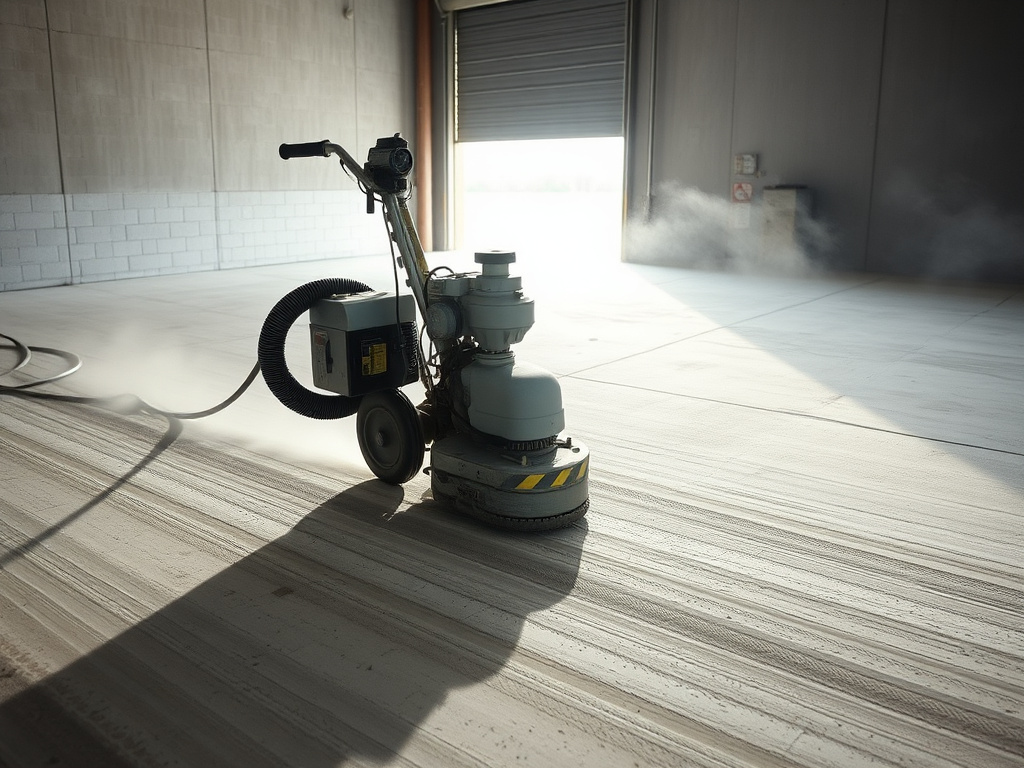
Diamond grinding, shot blasting, crack chase-and-fill, spall rebuild and moisture vapor testing. This is the half of the job nobody photographs and the half that decides whether the finish is still there in ten years.
The uncomfortable truth
Coatings almost never fail. Bonds fail.
When a garage floor in Gilbert peels up in dinner-plate sheets after fourteen months, the homeowner blames the product. Flip one of those sheets over and the story is written on the back of it: a smooth grey film of cement paste stuck to the underside of the coating. The coating did not let go of the concrete. A thin, weak layer of concrete let go of the rest of the concrete — because nothing ever removed it.
That layer is laitance: fines and water that rise during finishing and cure into a soft skin on top of a sound slab. Power troweling burnishes it and makes it worse. A coating applied over laitance is bonded to something with a tensile strength of maybe 50 psi sitting on a slab with 3,000 psi underneath it. The system is only ever as strong as its weakest layer, and the weakest layer is the one a grinder is supposed to remove.
There are exactly four things that cause a coating to fail, and three of them are prep. Inadequate mechanical profile. Unmitigated moisture vapor drive. Surface contamination — oil, sealer, cure compound, silicone. The fourth is applying the wrong system for the service condition. Chemistry defects are so rare in the field that we have stopped considering them.
This is why prep is the largest labor line on an honest quote and the first line a low bidder cuts. If two bids on the same Phoenix garage are $1,800 apart, the difference is almost never the resin. It is whether somebody planned to spend a day grinding.
Read the back of a failed chip
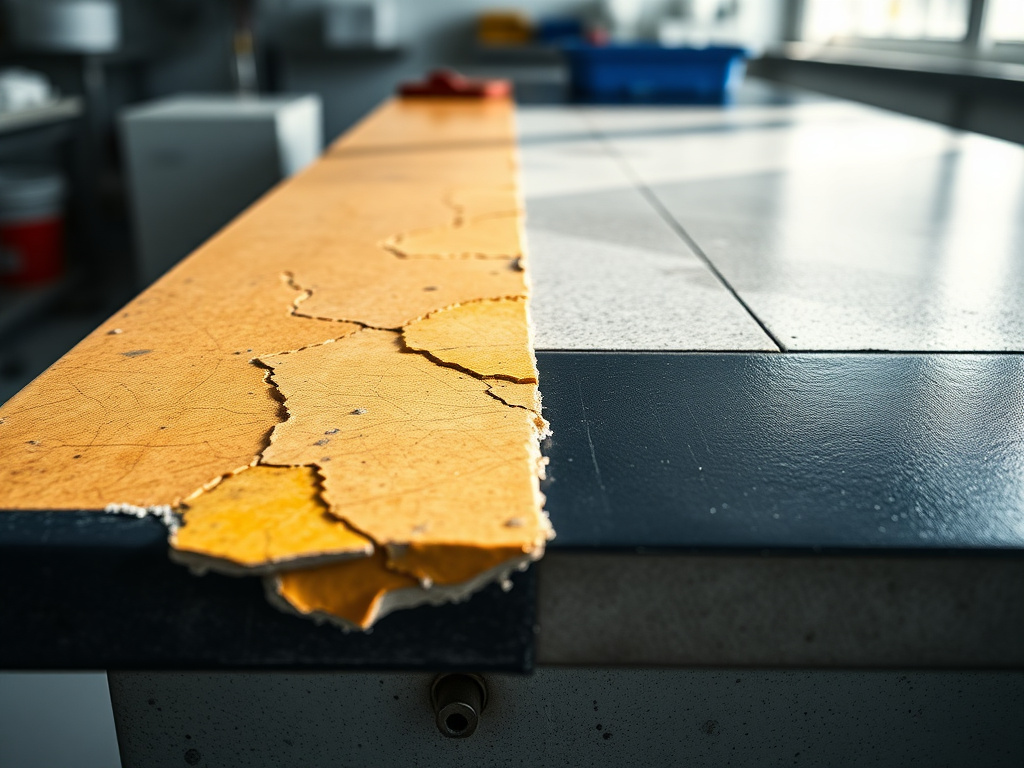
A failed coating chip tells you exactly what went wrong before anybody says a word.
- ✓Grey powder on the back — laitance was never ground off
- ✓Clean, shiny, paint-smooth back — bonded to sealer or a cure compound
- ✓Bubbles or white crystals — moisture vapor drove through the slab
- ✓Aggregate torn out with it — the bond was fine, the concrete failed
- ✓Oily film with a fisheye pattern — contamination was coated over
Profiling methods
Diamond grind, shot blast, or acid etch — and why the third one is not on our menu
Diamond grinding
Planetary grinders with metal-bond diamond tooling cut the surface flat and open the pore structure. Grit selection sets the result: 30 to 40 grit metal bond for aggressive removal of coatings and hard-troweled paste, stepping up to finer tooling to refine the profile. The output is a controllable ICRI CSP 1 to 3 — the right target for a residential garage flake system, a pool deck or a showroom floor.
Grinding also does something blasting cannot: it flattens. It knocks down trowel ridges, high spots at joints and slab curl at the perimeter, which matters when a thin decorative system will telegraph every one of them.
Shot blasting
A centrifugal wheel throws steel shot at the slab, fractures the surface and recovers the shot and debris in one enclosed pass. It is faster than grinding on open floor area and produces a deeper, more uniform ICRI CSP 3 to 5 — which is what a high-build industrial floor or a 125-mil containment lining needs to key into.
It has limits. Blasters do not reach walls, corners or tight geometry, so nearly every blasted floor also needs edge grinding. And blasting follows the existing contour rather than flattening it. On soft or contaminated slabs the shot can embed rather than cut, which is why we test a section first.
Acid etching
Acid etching dissolves cement paste chemically. It is cheap, it needs no equipment, and it is the single most common reason a coating peels. The profile it produces is shallow and wildly inconsistent — roughly CSP 1 on a good day and nothing at all where the slab is hard-troweled, sealed or oily, because acid cannot attack what it cannot reach.
Worse, it leaves reaction salts in the pore structure. Unless they are fully neutralized and flushed — which requires water the slab then has to release — you have built a coating on top of a contaminant layer. We do not acid etch. Ever. Not on garages, not on patios, not on a rushed schedule.
One more method worth naming: scarifying. Rotating cutter drums remove heavy buildup fast and leave CSP 6 to 9, far too aggressive for a coating on its own. We use it as a bulk-removal step on thick mastic or failed industrial epoxy, then grind the tracks out before profiling properly.
Standards we work to
The prep line item, written out in full
Most coating quotes describe prep in four words: "surface preparation included." That sentence is doing an enormous amount of work and revealing nothing. Below is what our prep scope actually specifies, and what yours should specify no matter who you hire.
If a bid does not name a profiling method, a CSP target and a moisture test, you are not comparing it to anything. Ask. A contractor who grinds will happily tell you the tooling and the grit — it is the most expensive thing they do.
| Diamond grinding | Planetary grinders, metal-bond tooling, 30–80 grit for profiling; produces ICRI CSP 1–3 |
|---|---|
| Shot blasting | Steel shot centrifugal blast; produces ICRI CSP 3–5 for high-build and containment systems |
| Dust control | Shrouded heads on HEPA extraction; containment sheeting in occupied spaces |
| Moisture — vapor emission | ASTM F1869 calcium chloride, target under 3 lbs / 1,000 sq ft / 24 hr |
| Moisture — internal RH | ASTM F2170 in-situ probes at 40% slab depth, target under 75–85% depending on system |
| Crack treatment | Chased to 1/4 in. wide × 1/4 in. deep minimum, vacuumed, filled with 100% solids polyurea |
| Spall and pit repair | Saw-cut square shoulder, primed, rebuilt with rapid-cure polyurea mortar, ground flush |
| Joint treatment | Control joints filled semi-rigid and shaved flush; expansion joints honored through the coating |
| Moisture mitigation | 100% solids epoxy vapor-reduction primer where testing requires it |
| Adhesion verification | Pull-off testing per ASTM D7234 on questionable or previously coated slabs |
| Bond strength target | Failure in the concrete substrate, not at the coating interface |
| Old coating removal | Grinding, blasting or scarifying — mastic, carpet glue, sealer, epoxy and paint |
Standard prep and repair scope. Targets tighten for containment, kitchen and high-build industrial systems.
The sequence
Assess, test, profile, repair, verify
On a residential garage this is a morning. On a 60,000 square foot Tucson distribution floor it is most of the project — and it is the part that has to be right before a single gallon is opened.
Assess
Slab age, finish hardness, prior coatings, crack map, joint layout, drainage and slope, existing contamination.
Test
Calcium chloride and in-situ RH probes, adhesion pulls on any existing film, and a water-drop check for sealer.
Profile
Diamond grind or shot blast to the CSP required by the specified system. No acid, no shortcuts, HEPA extraction throughout.
Repair
Chase and fill cracks, saw-cut and rebuild spalls, fill control joints, treat pits and bug holes, then re-grind flush.
Verify
Vacuum, inspect under raking light, confirm profile and dryness, prime if mitigation is required, then release to coating.
Moisture vapor transmission
The failure mode nobody sees coming in a desert
Arizona homeowners find this counterintuitive. It is the driest climate in the country — how is moisture the problem? The answer is that concrete does not care about the air above it. It cares about the ground beneath it, the irrigation schedule next to it, and whether anybody put a vapor retarder under the pour in 1978.
A slab-on-grade sits on soil that wicks. Water vapor migrates upward continuously, driven by the difference in vapor pressure between the wet subgrade and the dry surface. As long as the top is open, that vapor evaporates and nobody notices. Seal the top with an impermeable coating and the vapor now collects at the interface, builds osmotic pressure, and pushes the film off the slab. You see it as blisters, then as white efflorescence rings, then as delamination.
Landscape irrigation makes this dramatically worse and is genuinely an Arizona signature. Drip lines and lawn heads running along a garage or patio wall put water directly against the slab edge every day of the year. We routinely find high readings on one side of a Scottsdale garage and normal readings twelve feet away.
So we test rather than assume. Calcium chloride kits per ASTM F1869 for vapor emission rate, and in-situ RH probes per ASTM F2170 drilled to 40 percent of slab depth for the more meaningful internal reading. Where results exceed the threshold for the specified system, we install a 100 percent solids epoxy vapor-reduction primer before anything else goes down. That primer costs money. It costs less than doing the floor twice.
Contamination: the other invisible bond breaker
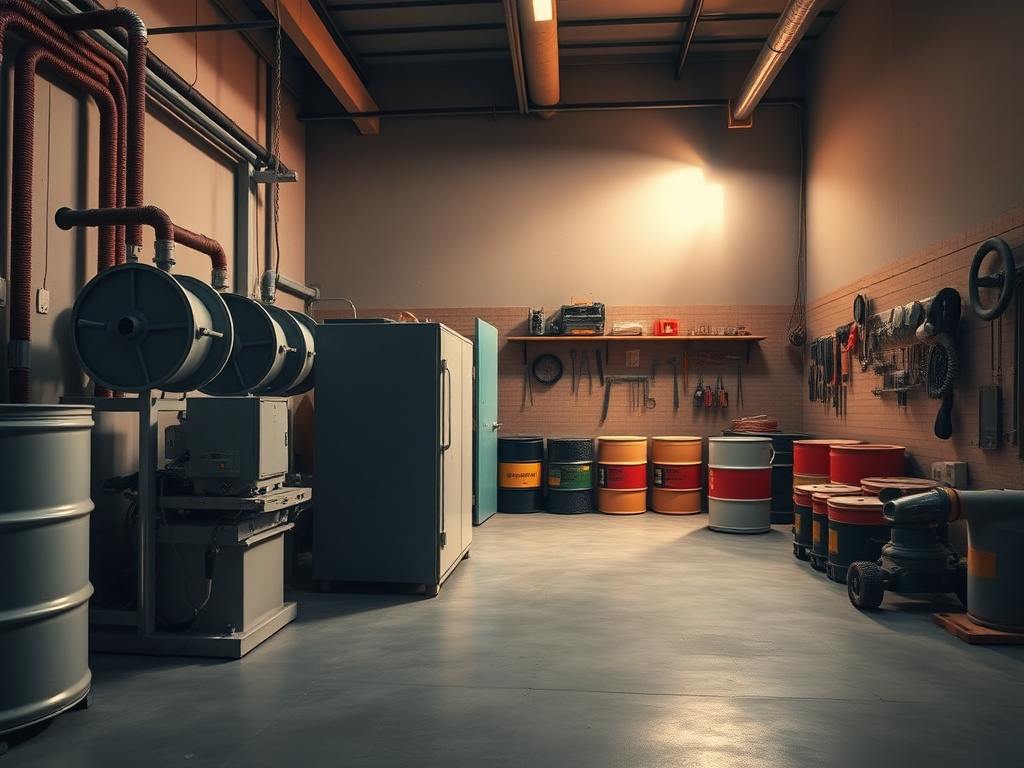
- ✓Motor oil and transmission fluid — soaks deep; degreased, then ground, then flame- or poultice-treated if it wicks back
- ✓Concrete sealers and cure compounds — a water drop that beads instead of darkening means grinding, not cleaning
- ✓Silicone and tire dressing overspray — causes fisheyes; must be removed mechanically
- ✓Carpet mastic, tile thinset and glue — scarified or blasted off, never coated over
- ✓De-icing salt residue in Flagstaff and Prescott slabs — flushed and neutralized before profiling
- ✓Efflorescence — a symptom of moisture, not a cleaning problem; it will return until the source is addressed
Repair
Cracks, spalls, pits and joints — what actually gets fixed
Crack chase and fill
Cracks get chased, not smeared. We follow the crack with a crack-chasing blade and open it to a minimum quarter inch wide by a quarter inch deep, which gives the filler real cross-sectional area instead of a hairline skim that shrinks and reappears.
The channel is vacuumed dry, then filled with a 100 percent solids rapid-cure polyurea slightly proud of the surface and ground flush once it kicks — usually within fifteen minutes. Static cracks disappear. Working cracks are detailed differently, because a crack that moves will move again and the honest answer is to bridge it with an elastomer, not pretend it is gone.
Spall and pit rebuild
Spalls — the broken-out craters common at Arizona garage door thresholds and dock edges — get saw-cut to a square shoulder around the perimeter. Feathering a repair to a knife edge guarantees it will chip loose; a vertical shoulder gives the mortar something to lock against.
The cavity is cleaned to sound aggregate, primed, and rebuilt with a polyurea or polyurethane mortar that cures harder than the parent concrete and is grindable the same day. Pitting and bug holes across a broader area get a full skim of the same material squeegeed and ground back, which is how a pitted 1980s slab becomes a coatable surface again.
Joints and slab curl
Control joints exist to tell the slab where to crack, and they have already done their job by the time we arrive. In a residential garage we typically fill and shave them flush so the finish reads as one surface. In heavy forklift traffic we fill them semi-rigid to armor the edges against wheel impact.
Expansion joints are different and are never filled rigid or coated blind. They are designed to accommodate real movement, and a coating sprayed straight across one simply becomes the new joint — it will split, and it will split unevenly. We honor them through the system with a detailed, flexible termination.
Perimeter slab curl gets ground down. It is the single most common reason a decorative floor looks wavy under a raking light after everything else was done right.
Removals
Taking off what somebody else put on
A large share of our residential work in Phoenix, Mesa and Chandler is second-round: a big-box epoxy kit or a low-bid install that peeled. The question is never whether the old film is pretty. It is whether it is bonded.
We pull-test the existing coating per ASTM D7234. If it passes and the failure mode is cohesive in the concrete, we can sometimes abrade and recoat. If the film releases cleanly at the interface — which is the usual result on an etched slab — it all comes off, because a new system bonded to a failed one inherits the failure.
Mastic, carpet glue, thinset, old sealer, cure compound, garage paint and industrial epoxy all have their own removal profile. Thick soft material scarifies; thin brittle material blasts; adhesive residue grinds with the right bond hardness. Getting that selection wrong is how a one-day job becomes three.
New construction
New pours, cure time and what to ask your concrete crew
Twenty-eight days is the conventional wait, and it is a sensible minimum, but the calendar is a proxy for the thing that actually matters — internal moisture. We test new slabs the same way we test forty-year-old ones.
The bigger issue on new construction is what got applied at finishing. Membrane-forming curing compounds are standard practice and are an absolute bond breaker. They have to come off mechanically; no solvent wash reliably removes them. If you know a floor is going to be coated, tell the concrete crew to use a dissipating cure or wet-cure it, and you will save real money on prep.
Also ask for a light broom or a soft-trowel finish rather than a hard burnish. Every pass of a power trowel densifies the paste and adds grinding time later.
Where a vapor retarder was installed under the pour, say so. It changes the moisture risk assessment entirely, and on a Flagstaff or Prescott project it changes the primer strategy too.
Prep questions
What people ask once they understand prep matters
Broader questions live in the FAQ, failure post-mortems on the blog, and the climate-by-climate detail on service areas. We prep slabs in Phoenix, Tucson, Mesa, Scottsdale, Chandler, Gilbert, Flagstaff and Prescott.
Book a slab assessmentWhy is acid etching bad if everyone sells it?
+
Acid etching is sold because it is cheap and needs no equipment. Hydrochloric or phosphoric acid dissolves cement paste, but it does it unevenly, it leaves behind salt residue that has to be fully neutralized and rinsed, and it cannot touch a slab that has been sealed, power-troweled hard, or contaminated with oil. Best case it produces a shallow, inconsistent profile around ICRI CSP 1. Nearly every peeling garage floor we tear out in Phoenix and Mesa was acid etched. We grind or blast, every job, without exception.
What is a CSP profile and which one does my floor need?
+
CSP is the ICRI Concrete Surface Profile scale, 1 through 10, running from an acid-etched near-smooth surface up to heavy scarified concrete. It describes how much texture the coating has to key into. Thin polyaspartic topcoats and sealers want CSP 1 to 2. A standard polyurea flake garage system wants CSP 2 to 3, which is a diamond grind with metal-bond tooling. High-build industrial and containment linings want CSP 3 to 5, which means shot blasting. Applying a thin coating over CSP 5 telegraphs the profile; applying a thick lining over CSP 1 delaminates.
How do you test a slab for moisture?
+
Two standard methods, and on any significant job we run both. ASTM F1869 calcium chloride testing measures moisture vapor emission rate in pounds per 1,000 square feet per 24 hours at the surface. ASTM F2170 in-situ relative humidity probes are drilled to 40 percent of slab depth and measure the RH inside the concrete, which is the better predictor because it captures what the slab will do after you seal the top. A plastic sheet taped down overnight is a screening trick, not a test.
Can you fix spalling and pitted concrete or does the slab need replacing?
+
Almost always repairable. Spalls get saw-cut to a square shoulder rather than feathered, cleaned to sound aggregate, primed and rebuilt with a polyurea or polyurethane mortar that is stronger than the surrounding concrete and cures fast enough to grind flush the same day. Full slab replacement is genuinely warranted for structural cracking, severe subgrade failure or heaving — and if that is what we find, we will tell you rather than coat over it.
How long does a new concrete pour have to cure before coating?
+
The old rule of thumb is 28 days, and that is a reasonable floor, but the real gate is moisture, not the calendar. A 28-day-old slab in a shaded Flagstaff garage can still be well above the threshold, while a summer pour in Phoenix that has been open to the sun may be ready. We test rather than count. New pours also need any curing compound removed mechanically — a membrane-forming cure agent is a bond breaker, and grinding is the only reliable way off.
Will grinding fill my house with concrete dust?
+
No. Every grinder we run is shrouded and connected to a HEPA-filtered dust extractor sized for the machine, and we use containment sheeting at the door line into the house. Occupied homes in Scottsdale and Chandler and live facilities in Tucson are the normal case, not the exception. You will hear it. You should not be cleaning up after it.
Services
Systems this prep supports
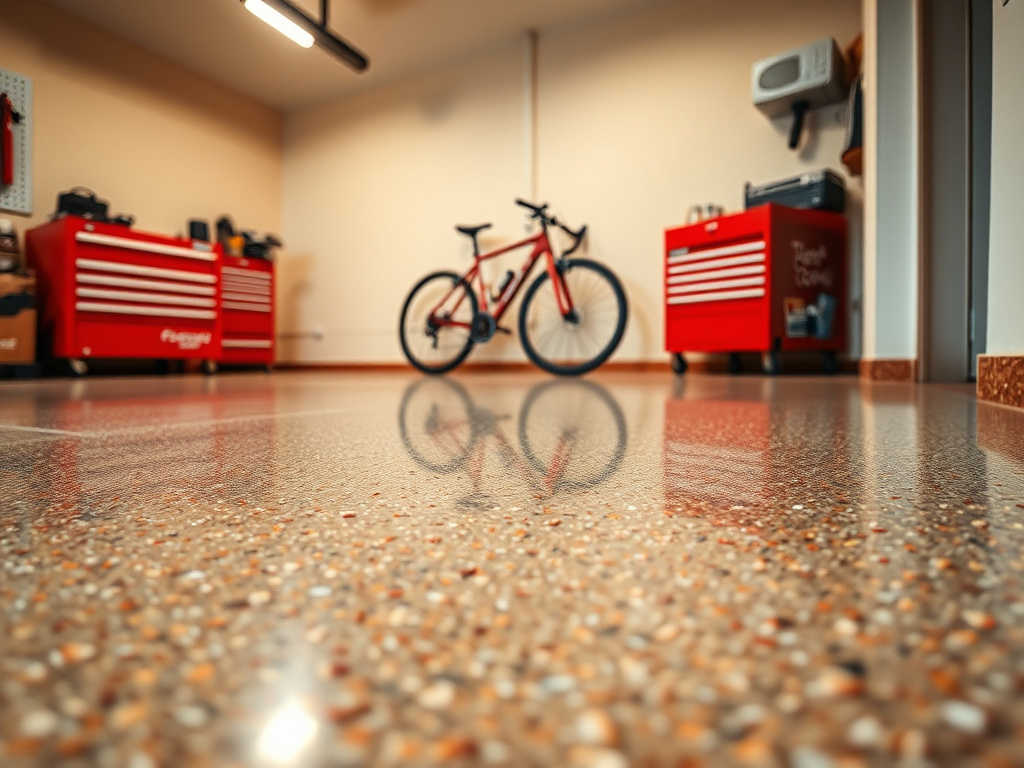
Garage Floor Coatings
One-day polyaspartic flake systems that shrug off hot-tire pickup, monsoon grit and 160°F slab temperatures.
Explore this system →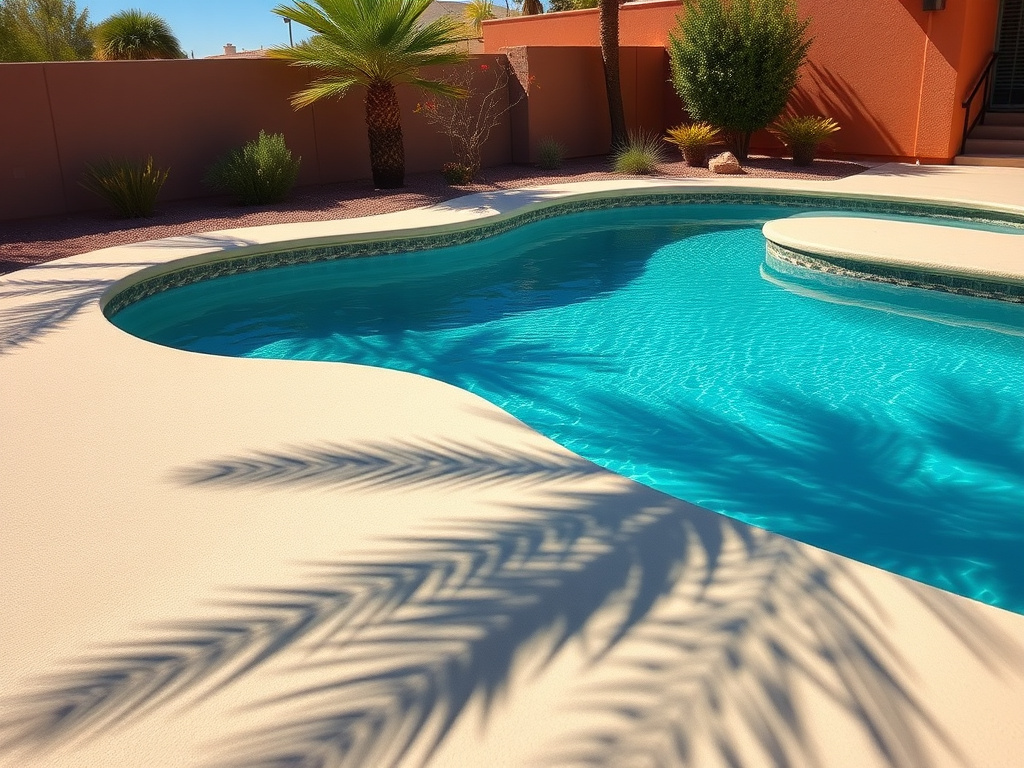
Patio & Pool Deck Coatings
Textured, heat-reflective cool-deck finishes that stay barefoot-friendly through a Phoenix July.
Explore this system →
Warehouse & Industrial Floor Coatings
Seamless high-build systems for distribution centers, plants and hangars — back in service the next shift.
Explore this system →Find out what your slab actually needs
We test before we quote. Moisture readings, profile assessment and an itemized repair scope — so the number you get is the number the floor requires.