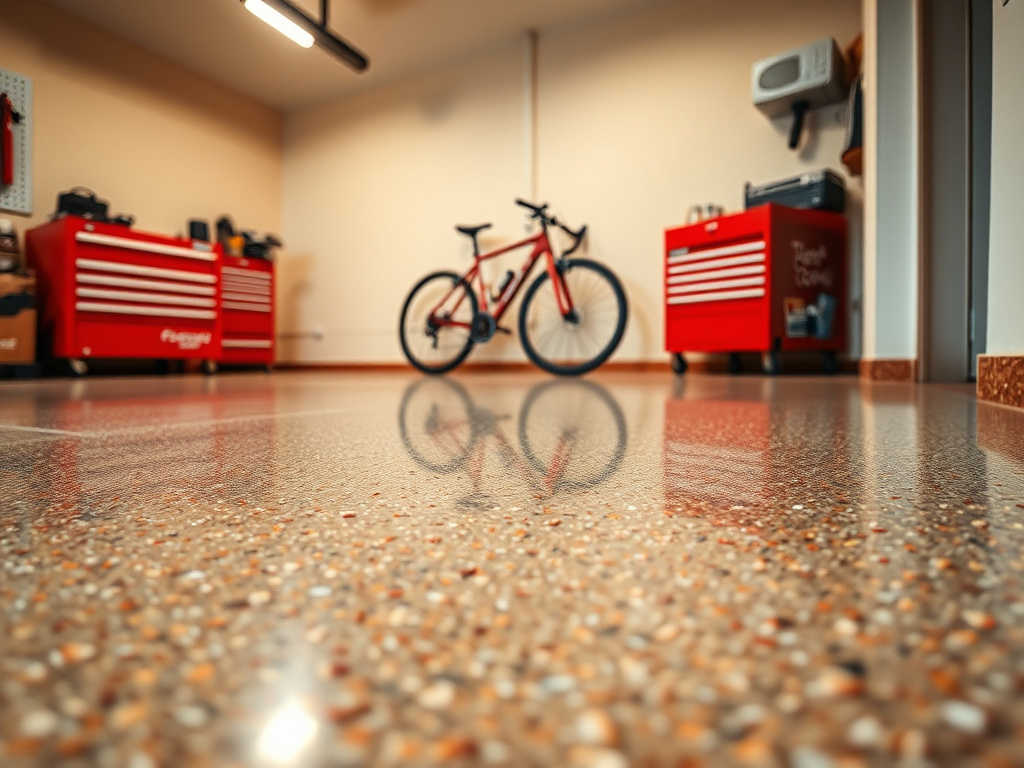
Residential · One-Day Install
Polyaspartic Garage Floor Coatings Across Arizona
A polyurea basecoat, a full vinyl flake broadcast and an aliphatic polyaspartic topcoat — ground in the morning, walked on that night, parked on the next day. Built for slabs that hit 160°F and tires that come home hotter.
20–30
Mils total dry film
1 Day
Grind to topcoat
24 Hr
Park on it
CSP 2–3
Ground profile
The failure pattern
Most Arizona garage floors we coat are the second coating that slab has worn
An attached garage in Phoenix is not a conditioned room and it is not really outdoors either. It is a west-facing concrete box with a large uninsulated metal door, and in August the slab under that door can sit thirty degrees hotter than the slab against the back wall. That thermal gradient runs across the same piece of concrete every single afternoon from May through September. Any coating on it has to expand, contract and hold adhesion through that cycle several hundred times a year.
Two failure modes account for almost everything we tear out. The first is hot-tire pickup. A vehicle coming off asphalt in Chandler or Gilbert parks with tires at 160–180°F, and if the coating on the floor has a glass-transition temperature below that, the film softens under the contact patch. As the tire cools it contracts and grips, and the next time the car pulls out it lifts a patch of coating with it. That is not a bonding failure in the adhesive sense — it is a softening failure, and it is the direct consequence of using an aromatic epoxy where an aliphatic system belongs.
The second is prep. Acid etching, which is what almost every big-box kit and every low-bid crew relies on, produces an inconsistent, chemically weakened surface with a dusty laitance layer the coating never truly keys into. It looks etched. It passes the water-drop test on a good day. And it delaminates in sheets eighteen months later, usually starting where a hose or a spilled drink introduced moisture from the edge. We have never once ground out a failed floor and thought the resin was the problem.
There is a third factor most homeowners never hear about: moisture vapor transmission. Older Scottsdale and central Phoenix slabs frequently sit on sand with no vapor retarder underneath. During monsoon season that soil wets up and the slab quietly pushes vapor upward at four, five, sometimes eight pounds per thousand square feet per day. A tight, low-permeability film over that drive builds osmotic pressure at the bond line and blisters. Testing takes twenty minutes. Fixing a blistered floor takes a full re-grind.
Everything in the specification below exists to close one of those three doors. If you want the underlying chemistry argument in full, read our polyurea vs epoxy comparison.
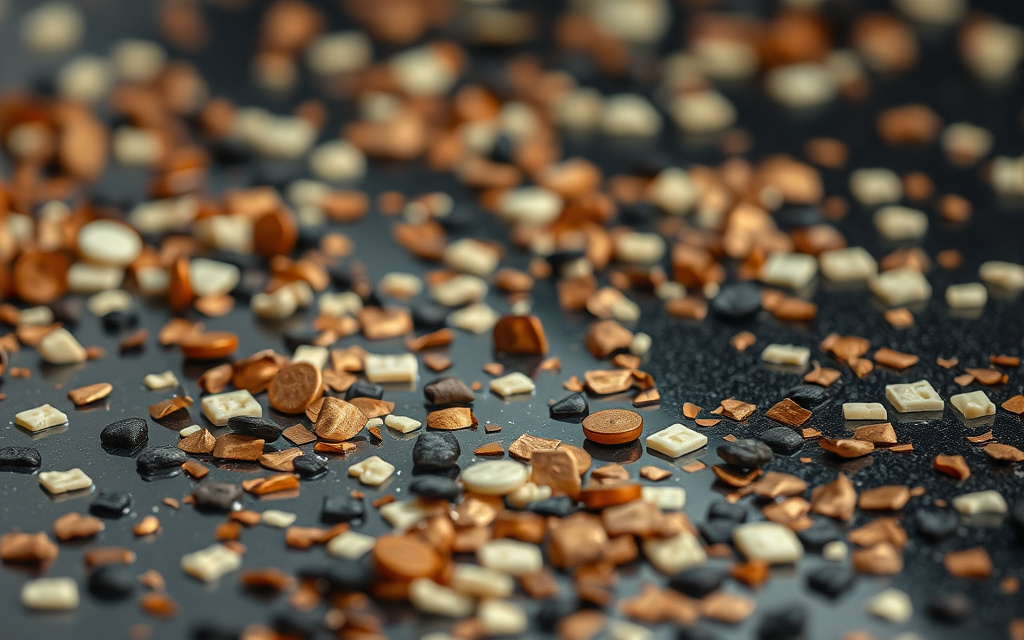
What a full broadcast actually buys you
Flake is not decoration. Broadcasting to refusal builds film, hides slab irregularity, and puts a mechanical texture under the topcoat that a partial scatter never delivers.
- ✓Adds 12–18 mils of build the resin alone cannot reach in one pass
- ✓Masks trowel marks, patch shadows and old saw cuts
- ✓Creates inherent traction before any additive goes in
- ✓Hides desert dust between sweepings far better than a solid color
System specification
Four layers, and the order they go down in is not negotiable
A garage floor is not one product. It is a stack, and each layer in the stack has exactly one job. The primer or penetrating polyurea basecoat wets the ground profile and drives resin down into the open capillaries the diamond tooling exposed — that is where adhesion actually lives, and it is why the grind matters more than the resin brand. On a slab that tested marginal for vapor drive we substitute a 100%-solids moisture-tolerant epoxy primer here, because that is the one place in the stack where epoxy genuinely outperforms.
The bodycoat is the polyurea, applied wet and immediately loaded with vinyl flake broadcast to refusal — meaning we keep throwing chip until the surface will not absorb another one. Refusal is a real, observable endpoint, and it is the difference between a floor that reads as a finished surface and one where you can see the resin between the chips at a low sun angle.
Once the flake has kicked, the crew scrapes the standing chip flat with carbide blades and vacuums the loose material. That scraping pass is the least glamorous hour of the day and the one that most determines how the floor feels barefoot. Skip it and you get a sandpaper floor. Overdo it and you cut into the flake and expose basecoat.
The topcoat is aliphatic polyaspartic, and it carries the whole burden of UV stability, gloss retention, chemical resistance and abrasion. In Phoenix and Tucson garages with a lot of glass or a door that stands open we run two topcoat passes rather than one thick pass, because film thickness uniformity matters more than raw thickness for color hold.
| System build | Polyurea basecoat + full vinyl flake broadcast + aliphatic polyaspartic topcoat |
|---|---|
| Total dry film thickness | 20–30 mils typical; 30–40 mils on shop and multi-bay slabs |
| Surface profile | ICRI CSP 2–3, diamond-ground with 30/40-grit metal-bond tooling |
| Basecoat gel time | 5–30 seconds plural-component; 20–40 minutes for hand-applied polyaspartic at 70°F slab |
| Elongation at break | 300–400% (elastomeric — bridges hairline slab movement) |
| Service temperature | −30°F to 250°F continuous; unaffected by 160°F Phoenix slab peaks |
| Taber abrasion (CS-17, 1 kg) | Typically 20–35 mg loss per 1,000 cycles on the polyaspartic topcoat |
| Slab moisture limit | Under 3 lb/1,000 sq ft/24 hr (ASTM F1869) or under 85% RH (ASTM F2170) without a mitigation primer |
| Return to service | Foot traffic 4–6 hours · vehicle traffic 24 hours · full chemical cure 72 hours |
| Slip resistance | Tunable from smooth-gloss to DCOF 0.60+ with 60–180 grit aluminum oxide or polymer bead |
Typical residential specification. Shop, multi-bay and RV-height garages are spec'd heavier — ask for the written build sheet with your quote.
The one-day install
Five steps between an empty garage at 6 a.m. and a finished floor at 4 p.m.
Three of the five happen before a coating pail is opened. That ratio is the whole reason a polyaspartic floor outlives the slab it sits on.
Moisture & Slab Test
Calcium chloride or in-situ RH probe, crack mapping, and an adhesion pull test on any existing coating before a number is written.
Diamond Grind
HEPA-shrouded planetary grinders open the slab to ICRI CSP 2–3. No acid etch, no chemical strip, no shortcut.
Chase & Rebuild
Saw-cut cracks, rebuild spalls and the door threshold with polyurea patch, then re-grind everything flush.
Base & Broadcast
Polyurea basecoat squeegeed and back-rolled, then vinyl flake broadcast to refusal while the film is still open.
Scrape & Topcoat
Excess flake scraped and vacuumed, then the aliphatic polyaspartic topcoat with your selected traction additive.
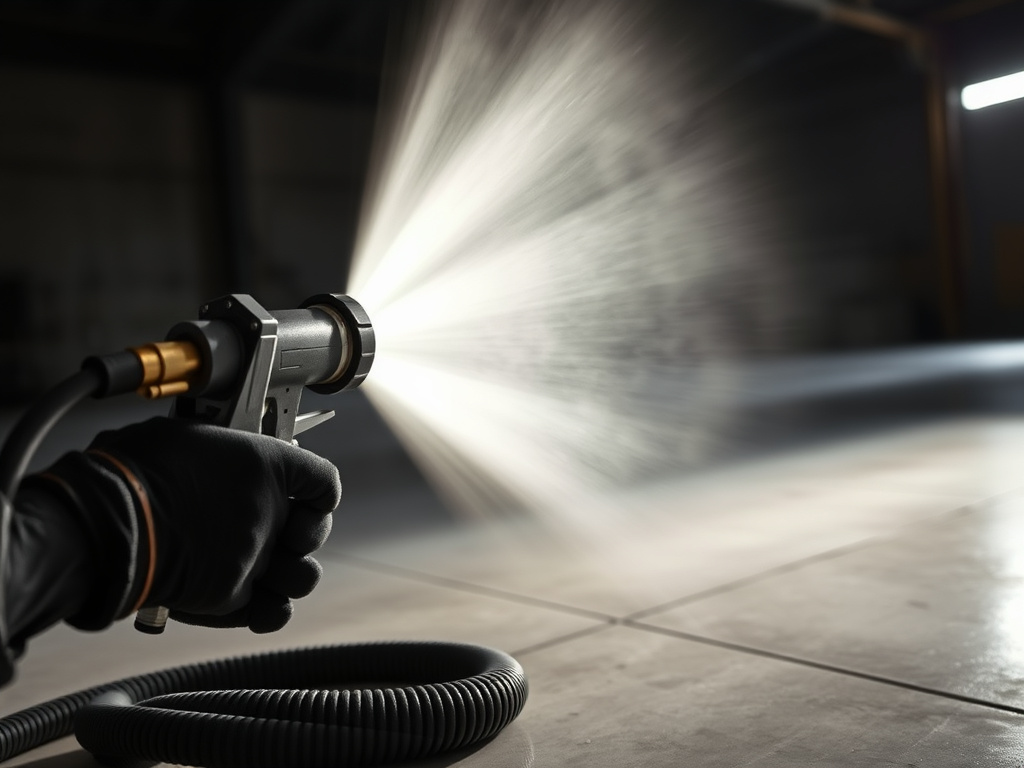
Heat engineering
Working time is the hardest variable on an Arizona install day
Every resin on the truck reacts faster as the slab warms. Managing that — not application skill — is what separates crews that can work here in July from crews that cannot.
160°F
Peak slab temperature
A closed Mesa garage slab in August routinely reads 130–140°F on an infrared gun, and the strip inside the door reads higher. We measure it every hour and adjust section size and catalyst load to match, rather than working to a fixed recipe.
8 min
Summer pot life
Polyaspartic working time roughly halves for every 18°F of substrate rise. A batch that gives 30 minutes at 70°F gives about eight at 105°F. We answer that with smaller mixed batches, more people on the squeegee, and 5 a.m. starts.
5°F
Dew point margin
Monsoon mornings in Tucson and Phoenix can put the slab within a few degrees of dew point. Coating over invisible surface condensation causes amine blush and blistering, so we hold a minimum 5°F margin above dew point before anything goes down.
Finish selection
Choose the flake blend for the light your garage actually gets
Flake blends read completely differently under a north-facing door in Prescott than they do under an open south-facing door in Scottsdale at four in the afternoon. Dark charcoal and espresso blends look sharp in a showroom and show every speck of caliche dust in a working garage. Mid-tone copper, granite and desert-tan blends are far more forgiving between sweepings, which is why they are the overwhelming favorite on Valley jobs.
Chip size changes the read as much as color does. A quarter-inch chip gives a fine-grained, almost terrazzo effect. A one-inch chip produces a bold, stone-like surface that hides more but feels coarser underfoot before the topcoat levels it. We bring physical samples to the walkthrough, because printed color cards lie under desert light.
Beyond flake we install solid-color polyaspartic for shops and utility spaces, quartz broadcast where maximum abrasion resistance matters, and metallic systems for showroom and collector garages — though metallics need a clean, level slab and a realistic conversation about their maintenance profile before anyone commits.
Traction
A garage is not a pool deck and should not be finished like one
Traction is a dial, not a switch. We set it per space, and we set it before the topcoat is mixed rather than trying to fix it afterward.
- ✓Smooth gloss — clean showroom look, best for dry-only collector garages
- ✓Fine polymer bead — light traction with no change to gloss or cleanability
- ✓180-grit aluminum oxide — the Valley default; grip when wet, still mop-friendly
- ✓60–80 grit aggressive broadcast — ramps, sloped driveways and wash bays
- ✓Integral cove base at the wall line where you plan to hose the floor out
- ✓Hard-edge cut-in at the door threshold so the coating terminates cleanly, not feathered
If the same crew is also doing your patio or pool deck, expect a different aggregate spec out there entirely — barefoot traffic and standing water change the target completely.
What moves the number
Square footage sets the floor. Slab condition sets the price.
Two identical 480 square foot two-car garages in Gilbert can differ by more than double, and the coating cost is nearly the same in both. Prep is the variable.
Get an itemized quoteWhen a bid comes in dramatically under the others, it is almost never because that contractor found cheaper resin. Resin is a commodity and everyone buys within a few dollars a gallon of everyone else. The savings come out of labor hours, and labor hours in this trade live almost entirely in preparation. A crew that plans to acid etch instead of grind saves four to six hours and several hundred dollars in diamond wear on a two-car garage, and hands you a floor with a three-year clock on it.
The honest cost drivers are these: total square footage and how it is shaped (long narrow bays cost more per foot than open rectangles); the amount of crack chasing and spall rebuild the grind exposes, which nobody can price accurately from a photograph; whether an existing coating has to come off and whether it comes off easily; whether moisture testing sends us to a mitigation primer; the flake or quartz system you select; and whether the job includes cove base, a driveway apron or an approach slab exposed to full UV.
We quote prep as a separate line rather than burying it, because that is the line worth comparing between bidders. Ask every contractor you talk to for their profiling method, their target dry film thickness, whether their topcoat is aliphatic, and what the warranty excludes. Four questions, and they sort the market fast. There are more of them on our frequently asked questions page.
Living with it
Maintenance is a broom, a mop and two things to avoid
A correctly built polyaspartic garage floor in Phoenix, Mesa or Flagstaff should run fifteen to twenty years before anyone talks about a refresh coat. Getting there is not complicated.
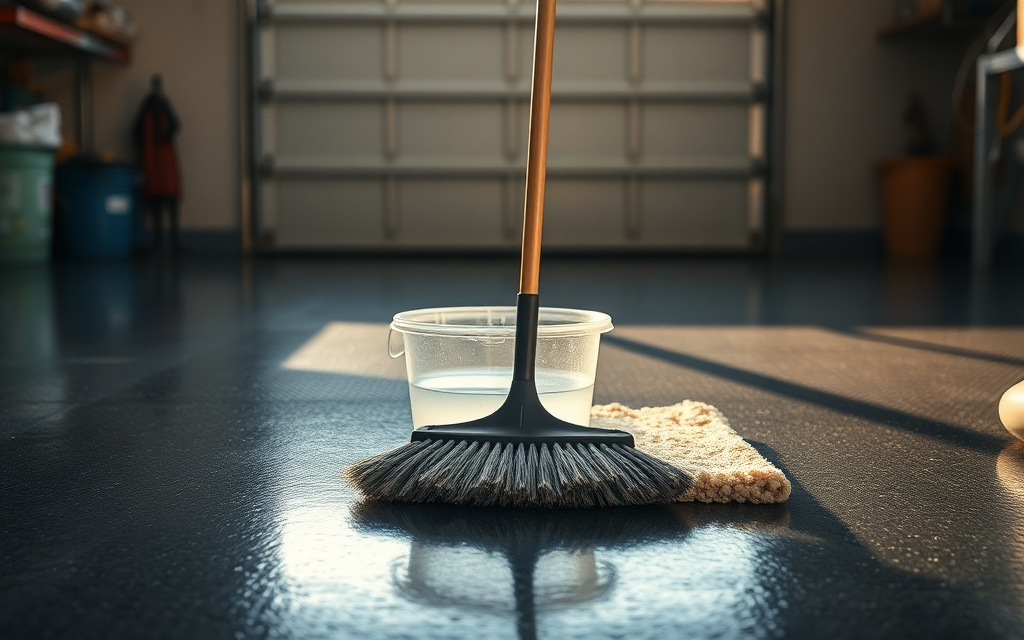
- ✓Dust mop or blow out weekly — desert grit is abrasive and grinding it underfoot is the main wear mechanism
- ✓Wet mop with a neutral-pH cleaner; skip degreasers with high solvent content and anything citrus-based
- ✓Wipe brake fluid, battery acid and gasoline reasonably promptly — the floor resists them, it does not enjoy them
- ✓Avoid cheap recycled-rubber mats; their plasticizers migrate and stain the film permanently
- ✓Use a plywood pad under jack stands only if you are also dropping tools, not for load reasons
- ✓Do not pressure wash at close range with a zero-degree tip at the door threshold edge
- ✓Expect a light refresh topcoat somewhere past year twelve in a heavily used bay, not a full tear-out
We install in every major Arizona market — Phoenix, Tucson, Mesa, Scottsdale, Chandler, Gilbert, Flagstaff and Prescott — and the high-country specification differs from the Valley one. More on that, plus heat and maintenance deep-dives, on the blog.
What is the difference between polyaspartic and polyurea on a garage floor?
+
Polyaspartic is a polyurea — specifically an aliphatic polyurea built on an aspartic ester resin instead of a straight amine. That chemistry slows the reaction from a five-second gel to a workable 20–40 minute pot life, which is what lets a crew squeegee and back-roll it by hand. On our garage builds the two work as a pair: a fast-set polyurea basecoat penetrates and bonds to the ground slab, and the aliphatic polyaspartic topcoat above it carries the UV stability, the gloss and the abrasion resistance. Anyone selling you one without the other is selling half a system.
How thick should a polyaspartic garage floor be?
+
A full-broadcast flake system in a Phoenix or Mesa garage should finish somewhere between 20 and 30 mils of total dry film. That is roughly 4–6 mils of basecoat wetting the profile, 12–18 mils of flake locked into the resin matrix, and 8–12 mils of polyaspartic topcoat divided across one or two passes. Single-coat installs that come in under 10 mils are the ones you see failing at the garage door threshold after two summers, because there is not enough film to bridge the profile peaks left by the grinder.
Will a polyaspartic garage floor lift when I park a hot truck on it?
+
Not when it is bonded correctly. Hot-tire pickup is a plasticizer-migration and softening problem: a tire that has just come off I-10 in July can hold 160–180°F, and an aromatic epoxy with a glass-transition temperature near 120°F softens under it, then the cooling tire grabs the softened film and peels a dinner-plate patch. Aliphatic polyaspartic has a much higher Tg and stays in its glassy state at those temperatures. Combine that with a real CSP 2–3 mechanical profile and the coating has nowhere to go.
Can you coat a garage floor in the middle of an Arizona summer?
+
Yes, with schedule discipline. We start early, monitor slab temperature rather than air temperature, and reformulate the catalyst ratio as the slab climbs. Polyaspartic pot life halves for roughly every 18°F of substrate temperature rise, so a 105°F slab that would give us 30 minutes of working time at 70°F gives us closer to eight. That is why summer garages get smaller working sections, more crew on the squeegee, and a 5 a.m. start rather than a 10 a.m. one.
How long before I can park on my new garage floor?
+
Foot traffic that evening, typically four to six hours after the topcoat pass. Vehicle traffic at 24 hours, and full chemical cure at roughly 72 hours. Those windows stretch in Flagstaff and Prescott, where a 45°F January slab slows the reaction considerably, and compress in a Gilbert garage in June. We give you the actual return-to-service times for your slab and your install day before we leave the site.
Do rubber mats or jack stands damage a polyaspartic floor?
+
Jack stands are fine — point-load compressive strength on a properly built system runs well past what a floor jack applies. Cheap rubber mats are the real hazard. Plasticizers migrate out of low-grade recycled rubber and stain almost any resinous floor a permanent amber-brown where the mat sat. If you want a mat, use a polypropylene or vinyl-backed one, or just let the coating do its job — it was built to be walked on, dripped on and scrubbed.
Services
Other systems we install on Arizona concrete
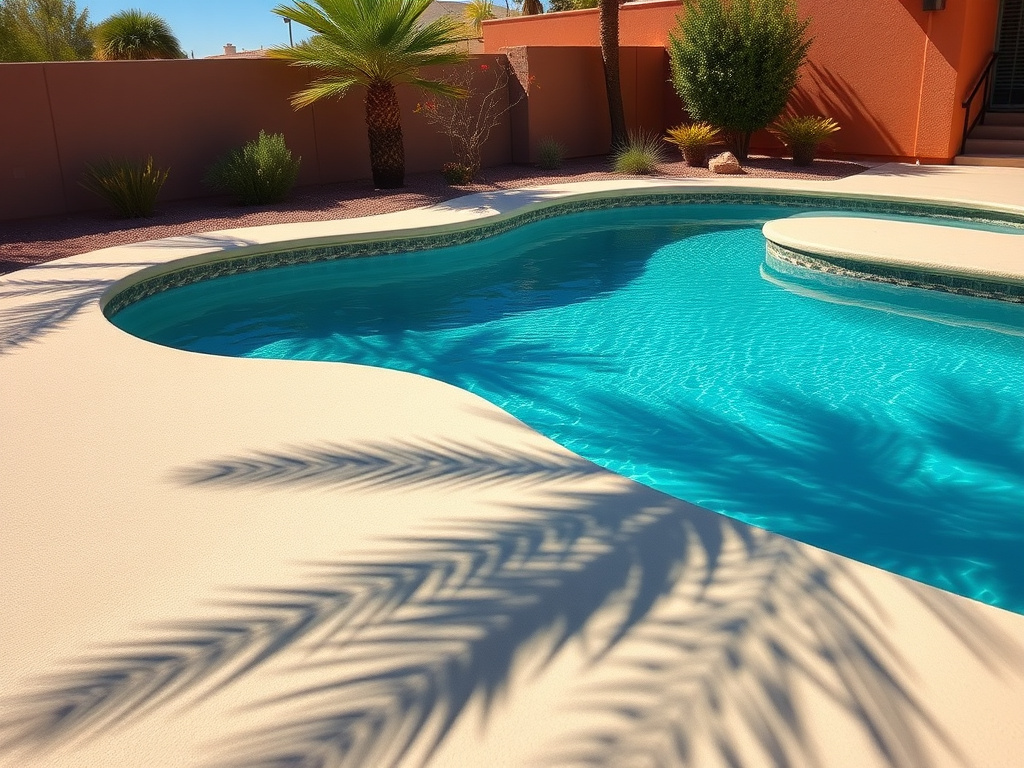
Patio & Pool Deck Coatings
Textured, heat-reflective cool-deck finishes that stay barefoot-friendly through a Phoenix July.
Explore this system →
Warehouse & Industrial Floor Coatings
Seamless high-build systems for distribution centers, plants and hangars — back in service the next shift.
Explore this system →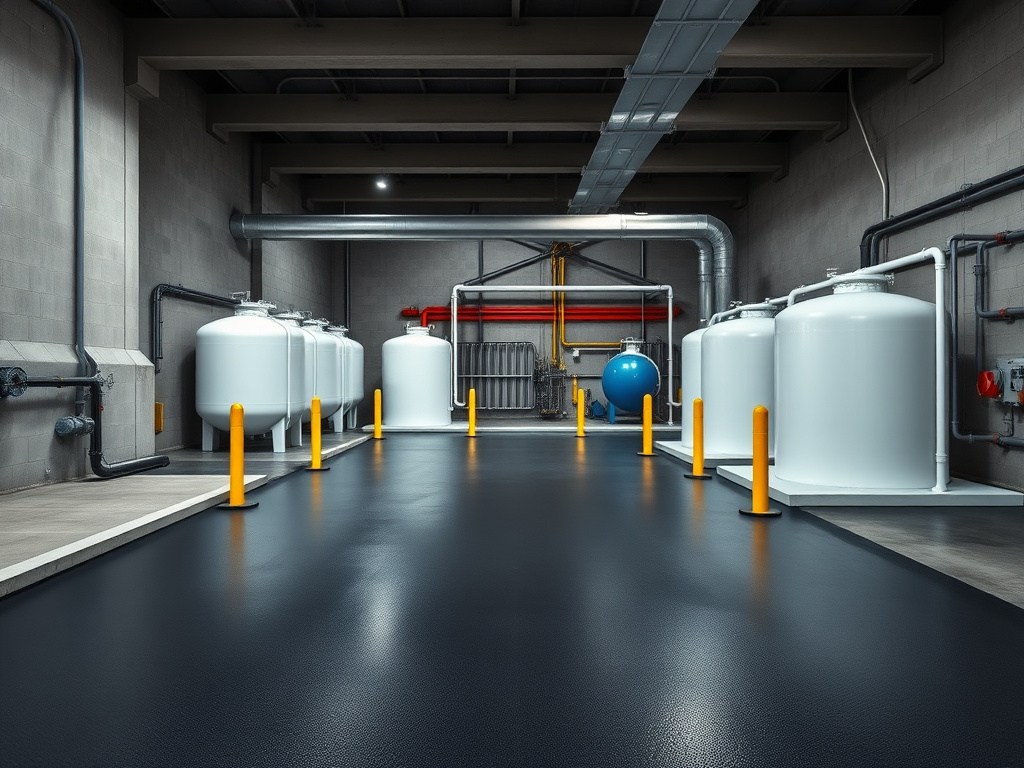
Secondary Containment & Tank Coatings
Monolithic chemical-resistant linings for berms, sumps, trenches and above-ground tank exteriors.
Explore this system →Get a free garage floor quote
Send us the bay count, the slab age and a photo or two. We will scope the prep on site and come back with an itemized, written number.