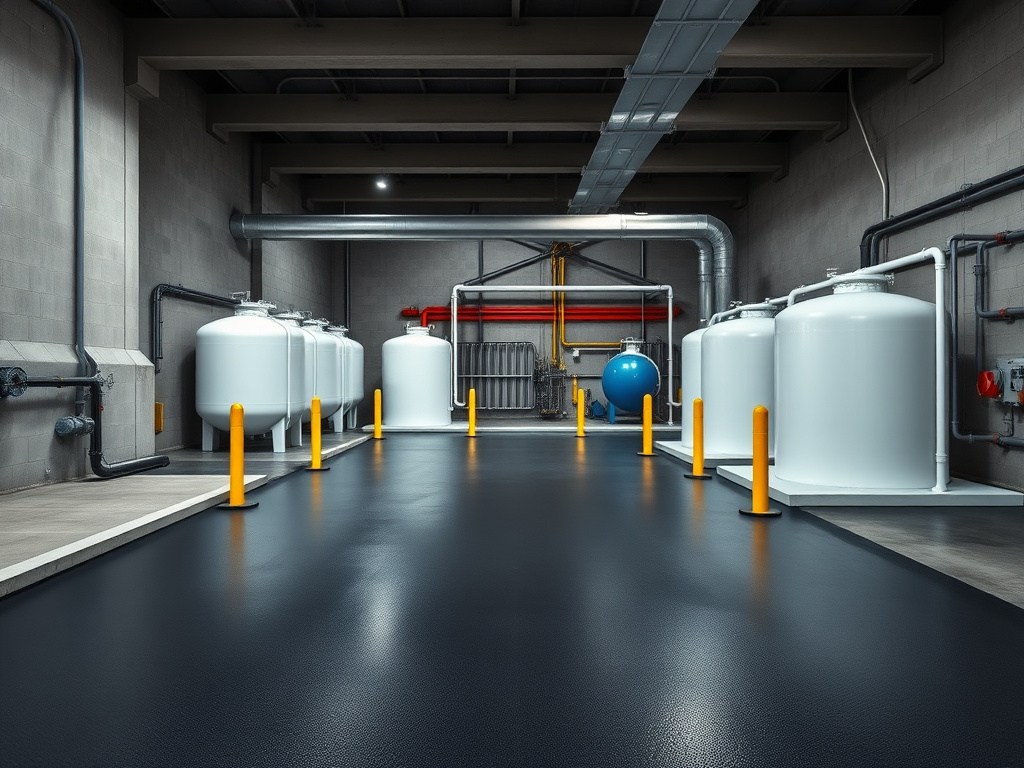
Industrial · Arizona Statewide
Polyurea Secondary Containment & Tank Coatings in Arizona
Seamless spray-applied linings for berms, dikes, sumps, trenches, truck loading pads and above-ground tank exteriors — engineered for the chemistry you store and the desert that surrounds it.
A different problem than a floor
A containment lining is not a floor coating with a bigger number on it
A garage floor has to look good and survive tires. A containment lining has to hold a liquid that would otherwise be in the soil, for as long as it takes somebody to notice and pump it out — and it has to do that after ten years of 115°F ambient, monsoon flooding, UV bombardment and forklifts running the berm apron. The two jobs share a material family and almost nothing else.
Concrete is not containment. Even a well-finished slab is a porous, jointed, shrinking material with a permeability that lets hydrocarbons wick straight through over time. Berm walls crack where they meet the floor because that cold joint is a hinge. Sumps crack because they are thin sections restrained on all sides. Penetrations leak because the pipe and the slab move at different rates in the same temperature swing. Every one of those is a designed-in leak path, and every one of them is why a sprayed elastomeric membrane exists.
Spray-applied polyurea solves it by being monolithic. There are no sheet seams to weld, no lap joints to fail, no mechanical fasteners penetrating the barrier. The membrane goes down as one continuous piece across the floor, up the wall, over the top of the dike, around every pipe and anchor bolt, and terminates in a cut keyway. Where a welded HDPE liner has thousands of linear feet of seam that all have to be perfect, a sprayed membrane has none.
And because polyurea gels in seconds, it can be sprayed vertically on a berm wall at full thickness without sagging or running — the single practical reason it beats every trowel-applied and self-leveling alternative on containment geometry.
What we line
- ✓Bulk storage berms and dikes — concrete, block, earthen with geotextile
- ✓Sumps, catch basins, trench drains and pump pits
- ✓Truck and rail loading and unloading pads
- ✓Above-ground tank exteriors, lids, skirts and saddle supports
- ✓Chemical mixing and batching room floors with cove and curb
- ✓Process trenches and equipment pads in food and beverage plants
Specification
The numbers that belong in your submittal
Film build is the specification. Everything else is a consequence of it. A membrane sprayed at 40 mils and a membrane sprayed at 125 mils are the same resin with wildly different service lives, and the only way to know which one you bought is a documented dry-film thickness grid.
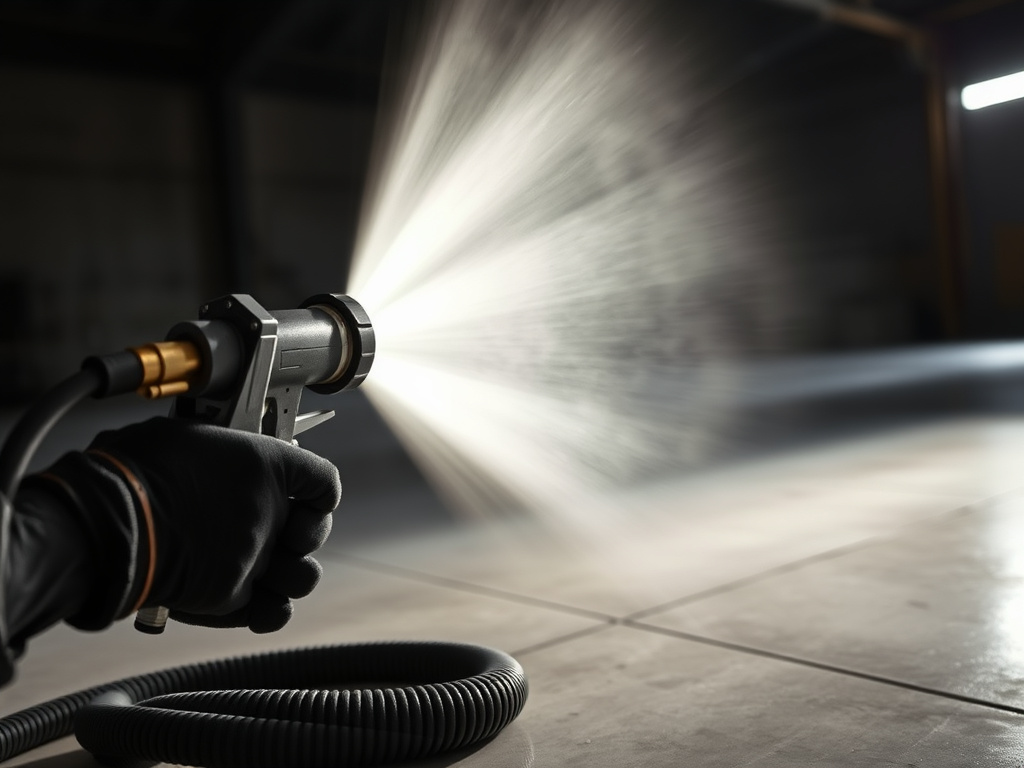
We spray with heated plural-component equipment running the A and B sides at roughly 150°F block temperature and 2,000 psi or better. That is not a preference — polyurea will not mix correctly at ambient pressure or cold, and an off-ratio spray produces a soft, tacky, chemically weak film that looks fine for six months and then fails everywhere at once.
| Membrane type | Pure two-component polyurea, plural-component spray applied, 100% solids, zero VOC |
|---|---|
| Film build — berm floor & walls | 80–125 mils monolithic, single-pass |
| Film build — sumps, trenches, loading pads | 125–250 mils, reinforced at transitions |
| Gel time / tack free | 3–8 seconds gel, 15–60 seconds tack free at 120°F block temperature |
| Return to service | Foot traffic in 1 hour, full chemical immersion service in 24 hours |
| Tensile strength | 2,200–3,000 psi typical |
| Elongation at break | 320–450% — bridges working cracks and joint movement |
| Tear strength | 350–500 pli (Die C) |
| Shore D hardness | 45–55 depending on grade selected |
| Service temperature | −30°F to 250°F continuous, short excursions higher |
| Concrete profile required | ICRI CSP 3–5 by shot blast; CSP 5 for high-build sump work |
| Steel profile required | SSPC-SP10 near-white blast, 2.5–3.5 mil anchor profile |
| Verification | DFT grid readings, adhesion pull test, high-voltage holiday detection |
Typical values for the pure polyurea grades we run on Arizona containment work. Final specification is set after product-compatibility review.
Chemical compatibility
Compatibility is decided before the rig ever leaves the shop
Every containment project starts with a product list — not a square-foot number. What is stored, at what concentration, at what temperature, and what happens during an upset. That list drives the resin selection, and occasionally it drives us to tell a facility that polyurea is not the right answer for the vessel interior even though it is perfect for the berm around it.
Pure polyurea performs extremely well against dilute mineral acids, caustics, brines, glycols, urea and ammonium nitrate fertilizer solutions, diesel, jet fuel, gasoline, hydraulic and gear oils, and de-icing chemistry. It handles intermittent splash from a much wider range than it handles full-time immersion in, which is why a berm and a tank interior get different answers from the same chemical.
Where it needs help: hot concentrated sulfuric and nitric acid, strong oxidizers, and some chlorinated and aromatic solvents that will soften or swell the elastomer under sustained immersion. In those cases we specify a novolac epoxy vessel lining inside and keep the polyurea where it belongs — on the containment structure outside, where impact resistance and crack bridging matter more than immersion performance.
Splash and spill is not immersion
This is the distinction most bidders skip. A secondary containment berm is a splash, spill and temporary-retention structure. It is designed to hold a release long enough for recovery, typically hours to days, not to store product indefinitely. A membrane rated for 72-hour retention of a given chemical may be entirely wrong for a tank that is full of it for twenty years.
Ask any bidder which one they are quoting you. If the answer does not distinguish between the two service conditions, the specification behind it is generic.
Arizona-specific factors
Uncovered berms in Phoenix, Mesa and Chandler take direct summer sun all day. Any aromatic polyurea left exposed will chalk and lose gloss — cosmetically ugly, and over enough years a genuine loss of surface integrity. We finish exposed containment with an aliphatic topcoat for UV stability. In Flagstaff and Prescott the design inverts: freeze-thaw cycling and de-icing salt make the elastomer's elongation the critical property, not its UV behavior.
How the work runs
Five stages, and only one of them involves spraying
On a typical containment job the spray itself is a few hours. The blast, the detailing and the verification are the project.
Product Review
You send the list of what is stored. We match resin chemistry to it and flag anything polyurea should not be asked to hold.
Survey & Test
Berm dimensions, freeboard, joint layout, penetration count, moisture vapor testing on the slab, coupon pulls on any existing lining.
Blast & Detail
Shot blast concrete to CSP 3–5, abrasive blast steel to near-white, cut keyways at terminations, rout and fill every crack and joint.
Spray Monolithic
Heated plural-component rig, 2,000+ psi, single continuous pass floor-to-wall with reinforcement fabric at cold joints and transitions.
Verify & Close
Thickness grid, adhesion pulls, holiday detection, punch repairs, and a documented closeout package with batch and ambient logs.
Detailing
Linings do not fail in the field. They fail at the edges.
Nobody has ever had a containment membrane fail in the middle of a flat berm floor. Failures happen at terminations, penetrations, cold joints, expansion joints, and the floor-to-wall transition — the places where the membrane has to change direction, change substrate, or stop.
Terminations get a saw-cut keyway. We cut a shallow reglet at the top of the dike wall, spray into it, and terminate the membrane inside the cut rather than feathering it out to a knife edge on an exposed surface. A feathered edge is an invitation for a boot heel or a pressure washer to start a peel.
Penetrations — pipe sleeves, anchor bolts, conduit stubs, sump pump bases — get the substrate cleaned back a minimum of four inches, a bond breaker where differential movement is expected, and a reinforced collar built up well above the field thickness. Where a pipe moves thermally against a fixed slab, we detail it with a flexible sealant band under the membrane so the movement is absorbed rather than transferred into the film.
Joints and cracks get routed to a defined width and depth, filled with a polyurea or polyurethane joint material to the correct depth-to-width ratio, and stripe-coated with reinforcement fabric before the field spray. Expansion joints are honored, never bridged blind — a joint that is designed to move will move, and a membrane sprayed straight over it becomes the joint.
Floor-to-wall transitions receive a cove and a fabric-reinforced stripe. That cold joint between a floor pour and a wall pour is the single most common leak path in a concrete berm, and it deserves more film than the field does, not the same amount.
Tank exteriors, lids and skirts
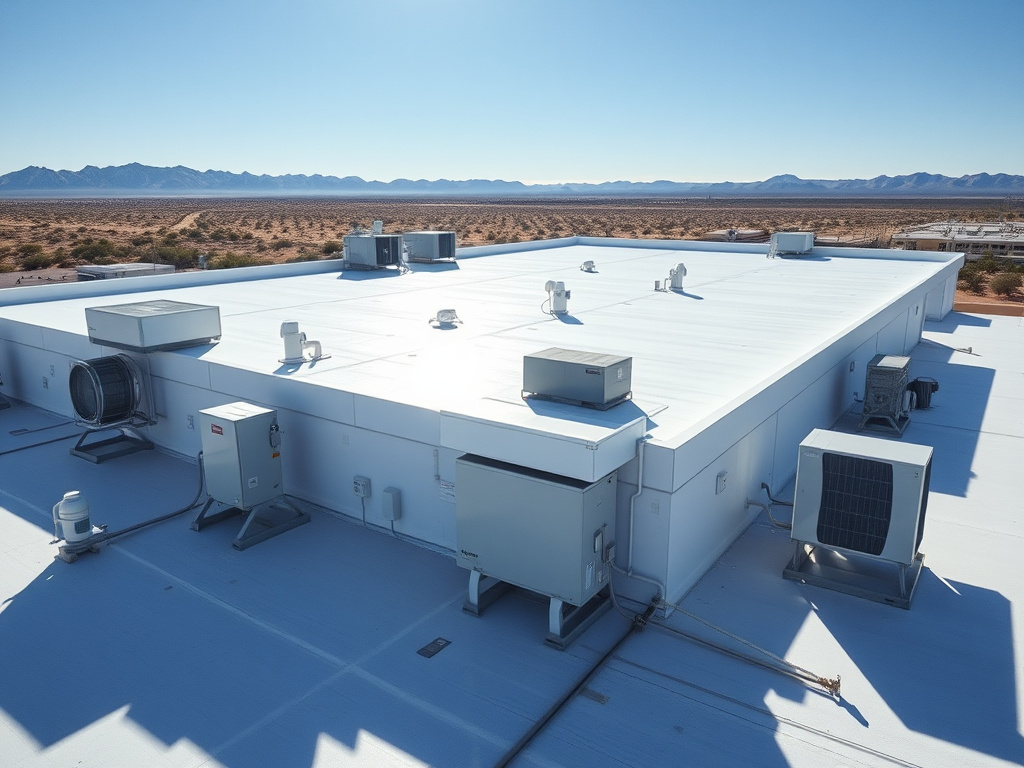
An above-ground steel tank in the Sonoran Desert lives a hard life: 60-degree daily surface-temperature swings, relentless UV, and monsoon-driven wind-blown grit that sandblasts the windward face for free. A sprayed polyurea exterior with an aliphatic reflective topcoat does three things at once — it stops corrosion at the steel, it bridges the shell-to-bottom weld seam and any pitting, and a light reflective finish measurably lowers shell temperature and therefore vapor loss.
Tank lids and roof surfaces are handled the same way we handle any flat exposed membrane — see roof and tank exterior coatings for the reflective-membrane specification.
Substrate prep
Concrete, steel and geotextile each get a different answer
On concrete we shot blast rather than grind. Blasting produces a deeper, more uniform ICRI CSP 3 to 5 profile than a grinder does, and high-build polyurea needs that depth of key. We also run moisture vapor testing before anything else — a calcium chloride test to ASTM F1869 or in-situ relative humidity probes to ASTM F2170. A slab pushing vapor will lift a 100-mil membrane just as reliably as it lifts a 10-mil one, and older Tucson and Phoenix industrial slabs poured without a vapor retarder do this constantly.
On steel we abrasive blast to SSPC-SP10 near-white with a 2.5 to 3.5 mil anchor profile and coat the same shift, before flash rust forms. On weathered or pitted steel we tie in with an epoxy primer and spray the polyurea into its recoat window.
Earthen berms and geotextile-reinforced containment get a different build entirely — fabric laid, seams overlapped and pinned, then sprayed to a heavier film so the membrane carries its own structure across the soft substrate.
Industries
Where this work actually happens in Arizona
- ✓Mining and mineral processing — reagent storage, leach pads, pump rooms south of Tucson
- ✓Agriculture — fertilizer and crop-protection bulk storage in Yuma and Casa Grande
- ✓Fuel and bulk petroleum — terminal berms, loading racks and tank farms
- ✓Water and wastewater — clarifier structures, chemical feed rooms, chlorine containment
- ✓Data centers and generator yards — diesel day-tank containment across the Phoenix metro
- ✓Food and beverage — CIP chemical rooms, process trenches and equipment pads
- ✓Aerospace and manufacturing — solvent storage and parts-washing containment in Mesa and Chandler
We mobilize statewide, including Flagstaff, Prescott and rural sites where the nearest alternative applicator is a five-hour drive. See service areas for mobilization and minimum job size on remote industrial work.
Shutdowns & safety
The schedule is the hardest constraint on every industrial job
Nobody empties a tank farm because a contractor wants a nice long cure window. The reason polyurea dominates industrial containment is that it collapses the outage. A cementitious or epoxy system needs days of cure before it can be flooded; polyurea is chemically resistant within hours of the gun shutting off.
That turns a week-long shutdown into a weekend. We regularly prep Friday, spray Saturday, verify Sunday morning and hand the area back Sunday afternoon.
Confined-space entry, hot-work permitting, lockout-tagout coordination and site orientation are handled through your process, not around it. Crews work in supplied-air or appropriate cartridge respiration depending on the space, with spotters and continuous atmospheric monitoring in sumps and pits.
Isocyanate spray requires exclusion zones and controlled ventilation. On live sites we coordinate the boundary with your operations lead before mobilization, not on the morning of.
Ambient conditions are logged and gated. We do not spray onto a substrate within five degrees of the dew point, and in the Arizona summer that mostly means we start early rather than that we stop. Monsoon season adds a genuine constraint on uncovered berms — humidity and a wet substrate both compromise the bond.
Every job closes with documentation you can hand to an auditor.
Containment questions
What facility managers ask before they spec
If your question is not here, it is probably in the general FAQ — or on the blog, where we go deeper on failure modes.
Request a site surveyHow thick does a polyurea containment lining need to be?
+
For a concrete berm floor and walls carrying hydrocarbons or process chemicals we typically specify 80 to 125 mils of pure polyurea in a single monolithic pass. Sumps, trenches and areas that see mechanical abuse from drums or hose drag get built to 125 to 250 mils. Anything under about 60 mils is a coating, not a lining — it will bridge a hairline but it will not survive a dropped fitting or a decade of thermal cycling on an uninsulated Yuma slab.
What containment capacity does my berm actually need?
+
The general rule most Arizona facilities design to is 110 percent of the largest single tank inside the diked area, plus displacement for the foundations and piping of every other tank in the same berm, plus allowance for precipitation if the area is uncovered. Some product-specific and state programs push that higher. We do not set your capacity requirement — your environmental engineer or plan does — but we do measure the existing berm, calculate the freeboard you actually have after our film build, and tell you if the wall height is short before we spray anything.
Can polyurea be sprayed directly onto steel tanks?
+
Yes, and it is one of the best substrates for it, provided the steel is abrasive blasted to a near-white or commercial finish with a 2.5 to 3.5 mil anchor profile and coated inside the same shift before flash rust forms. On weathered or pitted steel we run an epoxy primer as a tie coat, then spray the polyurea into the primer while it is still in its recoat window. Blast, prime, spray, and verify — skipping the profile step on steel is exactly as fatal as skipping the grind on concrete.
How is the finished lining tested?
+
Three ways, and we do all three on industrial work. Wet-film and dry-film thickness readings on a grid so you can see the build is actually where the specification says it is. Adhesion pull testing to confirm the bond to the substrate rather than a cohesive failure in the concrete. And high-voltage holiday testing across the full membrane to find pinholes and thin spots invisible to the eye. Results go into a closeout package with the batch numbers and ambient conditions logged.
Which chemicals will the lining actually resist?
+
Pure polyurea handles dilute acids and caustics, brines, glycols, most fuels, hydraulic and lubricating oils, fertilizer solutions, and de-icing chemistry very well. Strong oxidizers, hot concentrated acids, and some aromatic and chlorinated solvents need a different resin family or a novolac epoxy vessel lining instead. Send us your product list before design. If polyurea is the wrong chemistry for what you store, we would much rather say so at the quote stage than after the membrane is down.
How long is the containment area out of service?
+
Far less time than any epoxy or cementitious alternative. Polyurea gels in seconds and reaches handling strength in minutes, so a typical berm is prepped one day and sprayed the next, with the area returned to service the same evening the spray finishes. Most Phoenix and Tucson plants we work in schedule us into a weekend shutdown and are loading again Monday. The prep window, not the coating cure, is what sets the schedule.
Services
Related systems we install
Garage Floor Coatings
One-day polyaspartic flake systems that shrug off hot-tire pickup, monsoon grit and 160°F slab temperatures.
Explore this system →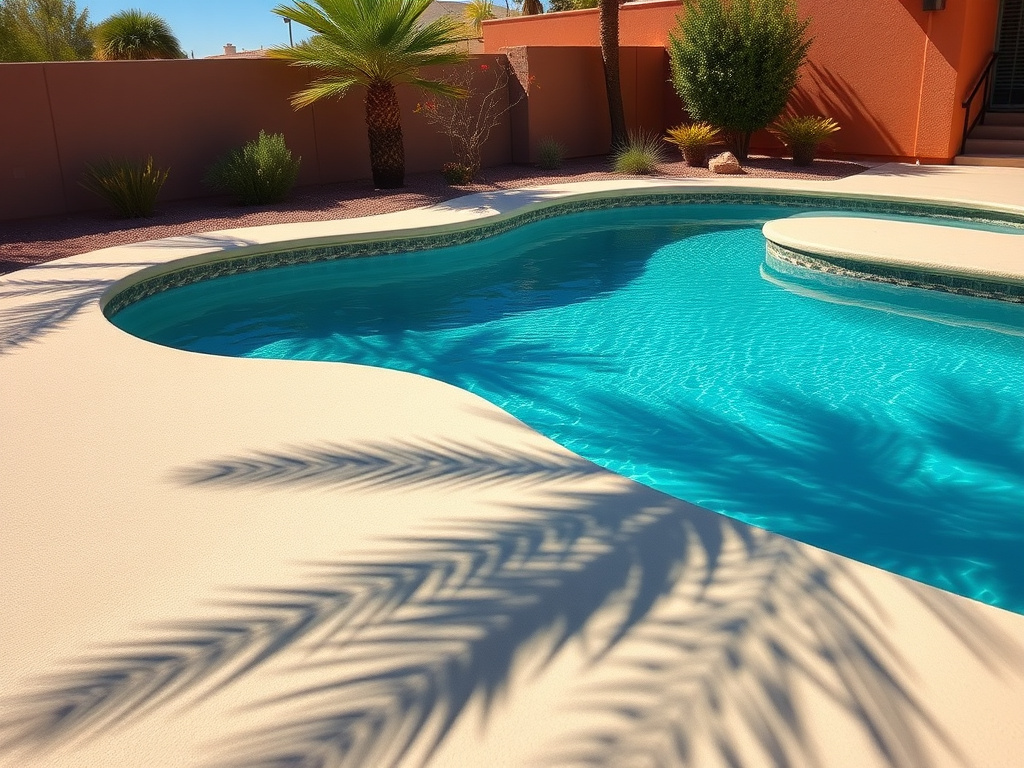
Patio & Pool Deck Coatings
Textured, heat-reflective cool-deck finishes that stay barefoot-friendly through a Phoenix July.
Explore this system →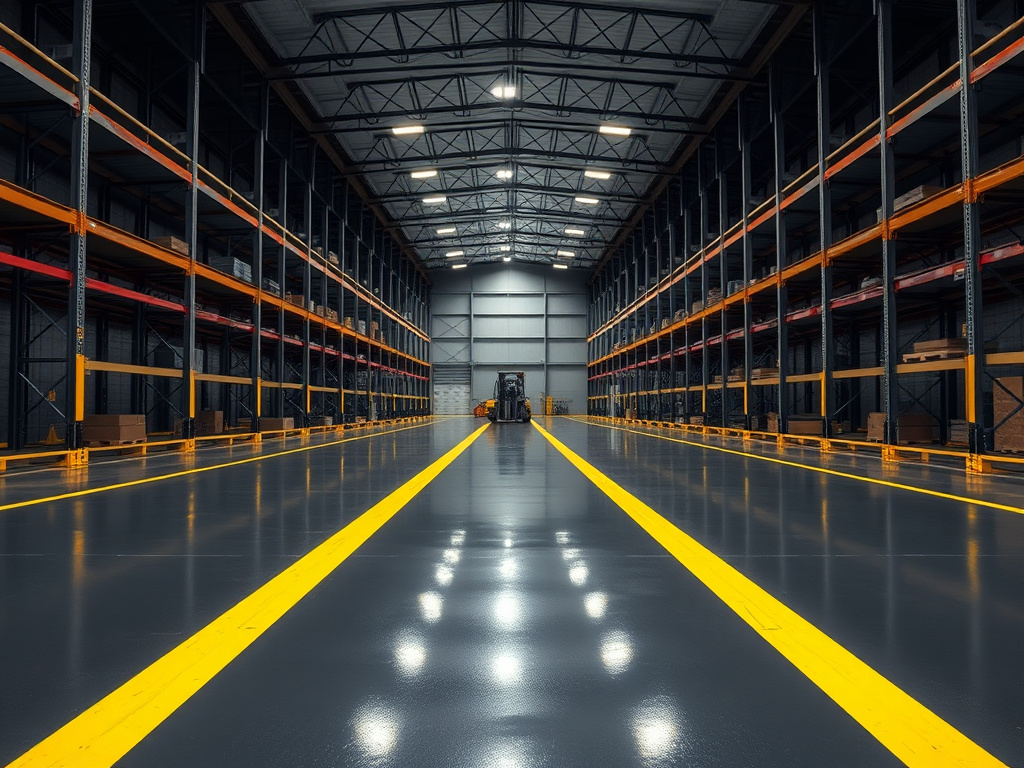
Warehouse & Industrial Floor Coatings
Seamless high-build systems for distribution centers, plants and hangars — back in service the next shift.
Explore this system →Get a containment lining scoped properly
Send us the product list and the berm dimensions. We'll come back with a film build, a detailing plan and a documented verification scope — not a square-foot guess.