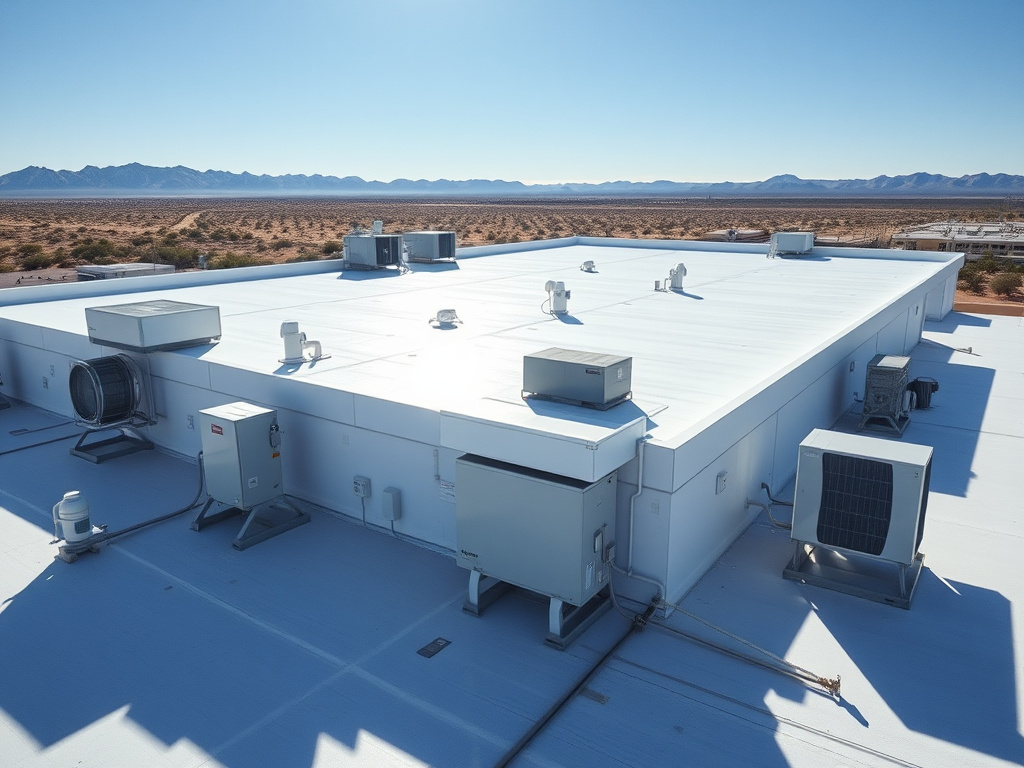
Roofs & vessels · Arizona statewide
Reflective Seamless Membranes For Arizona Roofs & Tanks
Spray-applied polyurea and silicone-hybrid systems that stop leaks, bridge existing seams and pull 40 to 70°F off a Phoenix roof surface — without a tear-off.
40–70°F
Typical surface temp drop
Seamless
No laps, no fasteners
Aliphatic
UV-stable topcoat
In-place
Restoration, no tear-off
The thermal load nobody designs for
An Arizona flat roof moves further in a day than most roofs move in a season
A dark commercial roof in the Valley can sit at 175°F at three in the afternoon in July and drop to 75°F by four in the morning. That is a hundred-degree swing across a single twenty-four-hour cycle, three hundred-odd times a year. Every material in the assembly expands and contracts through that swing at a different rate — the steel deck, the insulation, the membrane, the metal counterflashing, the curb framing — and every one of those differential movements is concentrated at a seam, a fastener or a penetration.
That is why aged Arizona roofs fail the way they do. Not usually a dramatic puncture in the open field, but seam splits, fastener back-out telegraphing through the membrane, cracked flashing at the parapet transition, and hairline separation around the base of every rooftop unit. Add a monsoon that delivers a season’s worth of water in six weeks, often driven sideways at fifty miles an hour, and every one of those small openings becomes a leak path in a matter of hours.
A seamless elastomeric membrane changes the failure geometry. There are no laps to split because there are no laps. There are no fasteners through the waterproofing plane. The membrane elongates over existing movement instead of tearing along a joint, and because it is monolithic, water that gets past a coping cap has nowhere lateral to travel.
The second benefit is thermal, and it is the one building owners notice first. A high-reflectance surface rejects most of the solar load instead of absorbing it. The membrane runs cooler, so it moves less, so it lasts longer — and the assembly below it stops cooking. On buildings with rooftop ductwork or marginal insulation, that surface temperature drop is felt inside the building on the same afternoon.
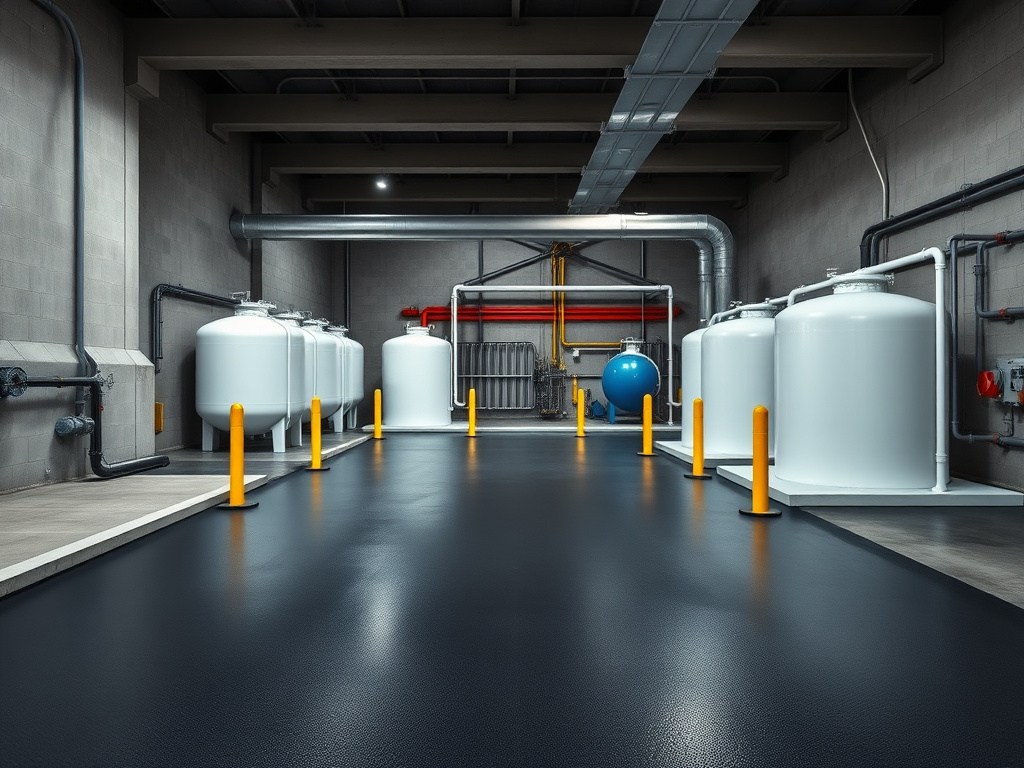
Tank exteriors: the same problem, standing up
A steel tank shell in Yuma or Casa Grande takes the same UV dose and the same daily thermal cycle as a roof, with the added difficulty that every coat has to hold on a vertical surface without sagging. Fast-gel plural-component polyurea sets in seconds, so it builds full specified thickness in one pass on a shell, a cone roof or a saddle — something a brush-and-roller system simply cannot do.
- ✓Water storage, process, fuel and chemical tank exteriors
- ✓Full thickness in one vertical pass — no sag, no runs
- ✓Pairs with the containment lining beneath the tank
Chemistry that decides the outcome
Aromatic builds it. Aliphatic protects it. Chalking is the tell.
If you only remember one technical distinction from this page, make it this one. It explains why two roofs coated with “polyurea” can look completely different after three Arizona summers.
Aromatic polyurea — the workhorse base
Built around aromatic isocyanates. It is tough, it elongates enormously, it goes on fast and thick, and it costs meaningfully less per gallon. Its weakness is ultraviolet light: UV photons have enough energy to break bonds in the aromatic ring, and the polymer degrades from the surface inward. Visually that shows up first as ambering, then as chalk — a fine powder you can wipe off with a hand. Under a topcoat, none of that matters. Left bare on a Phoenix roof, it is a countdown.
Aliphatic & silicone — the UV layer
Aliphatic polyurea and polyaspartic chemistry has no aromatic ring for UV to attack, so it holds color and gloss for years in direct sun. Silicone hybrids trade some abrasion resistance for exceptional weathering and genuine tolerance of permanent standing water. Both are more expensive per gallon, which is exactly why the correct roof build uses them as a thin protective wear-and-weather layer over a thicker, cheaper, tougher aromatic base rather than as the whole membrane.
The practical consequence for a building owner is that you should ask any bidder two questions: what chemistry is the base coat, and what chemistry is the topcoat. A single-product quote that never distinguishes between the two is either an all-aliphatic system you are overpaying for or — far more often in this market — a bare aromatic membrane that will look chalky by its third summer and be blamed on the weather. The same logic governs the topcoat we specify on a pool deck or an exposed garage apron.
Where roofs actually leak
Six details that decide whether the roof stays dry
The open field of a roof is straightforward. Nearly every service call in this trade traces back to a transition, a penetration or a termination — so that is where the reinforcement and the labor hours go.
Parapet walls & coping
The membrane runs continuously from the field, up the wall and over the top of the cap. Terminating at the base of a parapet puts a seam directly in the water path — which is precisely where most aged roofs are already failing.
Drains & scuppers
Stripped in with reinforcing fabric and dressed down into the drain bowl so water leaves under the membrane edge, not over it. Undersized or partially blocked drains get flagged before we quote, not after.
Curbs & rooftop units
Every HVAC curb, exhaust fan and skylight is wrapped and reinforced at the base. Equipment legs and condensate lines get individual detailing rather than a general spray-around.
Penetrations & conduit
Vent stacks, gas lines, conduit racks and electrical penetrations each get a fabric-reinforced collar. On a busy Arizona roof there can easily be sixty of them, and each one is its own potential leak.
Existing seam splits
Cleaned, reinforced with embedded fabric and bridged rather than simply sprayed over. An elastomeric membrane can span movement, but only if the substrate under it is not still working like a hinge.
Ponded low areas
Identified with a hose test and marked before any material goes down. Genuine low spots get tapered fill to restore fall; where fill is not practical, we specify a chemistry rated for permanent immersion.
Restoration sequence
Half of this job happens before any membrane is sprayed
A roof restoration that skips the moisture survey is not a restoration — it is an expensive lid on a wet assembly. We would rather lose the bid than coat over saturated insulation.
Core & Scan
Core samples plus moisture scanning to find wet insulation. Anything saturated is cut out and replaced before a membrane goes anywhere near it.
Adhesion Test
Pull tests on the existing surface and a small trial patch to confirm the primer and base chemistry actually bond to what is up there.
Clean & Prime
Power wash to remove chalk, biological growth and desert dust film, then prime per substrate — a smooth TPO takes a very different primer than aged gravel-surfaced bitumen.
Detail First
Reinforced fabric at every drain, curb, stack, seam and parapet transition, cured before the field coat begins.
Field & Topcoat
Spray the base membrane to spec thickness, then the reflective UV-stable topcoat. Wet-film gauges throughout, not eyeballed.
Arizona scheduling has its own rules. We work roofs in the shoulder seasons and the early morning through the summer, because substrate temperature governs both cure rate and applicator safety. Monsoon season compresses the workable window further — a membrane needs a defined dry period after application, and an afternoon storm cell that builds in ninety minutes will end a work day. We plan around it rather than gambling against it, which sometimes means a phased roof over several short mornings instead of one long push.
System specification
What goes on the roof, and why
Substrate drives the specification. An aged gravel-surfaced built-up roof, a chalky TPO, a rusting metal deck and a spray-foam roof each need a different primer and a different base chemistry, even when the finished membrane looks identical.
- ✓Moisture survey and core samples before a number is quoted
- ✓Adhesion pull tests on the actual existing surface
- ✓Wet-film thickness verified across the field, not estimated
- ✓Renewable in place — recoat instead of tear off at end of cycle
| Base membrane | Plural-component aromatic polyurea, sprayed seamless |
|---|---|
| Topcoat | Aliphatic polyurea, polyaspartic or silicone hybrid — selected for UV load and ponding exposure |
| Reinforcement | Polyester fabric embedded at all details, seams, curbs and penetrations |
| Elongation | Elastomeric — bridges thermal movement and existing seam splits rather than cracking along them |
| Ponding tolerance | Silicone and select polyurea systems rated for permanent standing water; acrylics are not specified where ponding exists |
| Finish reflectance | High-reflectance white standard; tinted finishes available at reduced reflectance |
| Substrates | Modified bitumen, BUR, TPO, EPDM, PVC, metal, spray foam, concrete deck, steel tank shells |
| Recoat cycle | Renewable in place — a topcoat refresh restores reflectance without removing the membrane |
Final specification is confirmed after core sampling, moisture scanning and adhesion testing on your specific roof or vessel.
Building types we coat
Flat, low-slope, metal and vessel
Restoration makes the most economic sense on large, simple, sun-loaded roofs where a tear-off means disrupting the operation below. That describes most of the commercial building stock in Arizona.
- ✓Distribution and logistics buildings across the Phoenix, Goodyear and Tolleson corridor
- ✓Light industrial, manufacturing and fabrication facilities
- ✓Retail centers, restaurants and multi-tenant strip properties
- ✓Municipal water and wastewater tanks, process vessels and pump houses
- ✓Metal buildings, hangars and agricultural structures in Yuma and Casa Grande
- ✓Self-storage, HOA common buildings and mid-elevation properties in Prescott and Payson
Straight answers
What facility managers ask about roof restoration
Including the ones where the honest answer is “a coating will not fix that.” Call 844-967-5247 and we will get on the roof before we quote it.
Request a Roof SurveyHow much can a reflective roof coating lower roof surface temperature?
+
On a dark aged modified-bitumen or single-ply roof in Phoenix, mid-afternoon surface temperature routinely runs 160 to 180°F in July. A clean, high-reflectance white membrane typically reads 40 to 70°F cooler at the same moment on the same roof. That is a measured surface delta, not an energy guarantee — how much of it reaches your utility bill depends on your insulation, your deck type and how much of your conditioned load is actually roof-driven. Buildings with thin or wet insulation and roof-mounted ductwork see the biggest change.
Will a coating fix ponding water on a flat roof?
+
It will waterproof through it, but it will not remove it. Ponding is a slope and drainage problem, and no membrane cures bad fall. What we can do is specify a chemistry that tolerates permanent immersion — some silicone and polyurea systems handle standing water indefinitely while most acrylics soften and re-emulsify in it — and, where the pond is caused by a low spot rather than a deck deflection, build a tapered fill to restore fall toward the drain. If the ponding comes from a structural sag or an undersized drain, we will tell you that before quoting a membrane over it.
What is the difference between aromatic and aliphatic polyurea outdoors?
+
It comes down to how the polymer backbone reacts to ultraviolet light. Aromatic polyurea is tougher per dollar and builds thickness fast, but UV breaks down its aromatic rings, so it ambers and then chalks — a powdery surface layer that washes off in the monsoon and slowly thins the membrane. Aliphatic chemistry has no aromatic ring to attack, so it holds color and gloss for years under direct sun. The right answer on a roof is usually both: an aromatic base coat for build and elongation, protected by an aliphatic or silicone topcoat that takes the UV load. Chalking on a bare aromatic roof is not a defect; it is the material doing exactly what its chemistry says it will do.
Can you coat over an existing roof, or does it have to be torn off?
+
Most sound roofs can be recoated, and that is the main economic argument for this work — a restoration keeps the existing assembly, the insulation and the tear-off cost out of the project, and it keeps thousands of square feet of roofing out of a landfill. What it requires is verification: core samples to confirm the insulation is dry, adhesion pull tests on the existing surface, and infrared or moisture scanning across the field. Wet insulation must be cut out and replaced regardless. A membrane installed over saturated insulation traps the water and the roof fails from underneath.
How are penetrations, parapets and seams detailed?
+
That is where roofs leak, so that is where the labor goes. Every curb, drain, vent stack, conduit penetration, skylight and equipment leg gets a reinforced detail — polyester fabric embedded in the base coat and wrapped up the vertical before the field membrane goes on. Parapet walls are coated continuously from the field, up the wall and over the top of the cap, so there is no termination sitting in the horizontal water path. A seamless membrane is only seamless if the details are done first; spraying the open field is the easy part of the day.
Do you coat above-ground tank exteriors as well as roofs?
+
Yes, and it is closely related work. Water storage tanks, process vessels, fuel and chemical tanks across Arizona take the same UV and thermal load as a roof, plus a vertical geometry that punishes any coating that sags during application. Fast-gel plural-component polyurea is well suited to that — it sets before it can run, so it builds full thickness on a vertical shell in one pass. Exterior tank work pairs naturally with the containment lining underneath it, so we frequently scope the shell exterior and the berm together.
Get a roof or tank exterior survey
Send us the square footage, the existing membrane type and the age. We'll core it, scan it, and give you a written restoration specification with a real number.