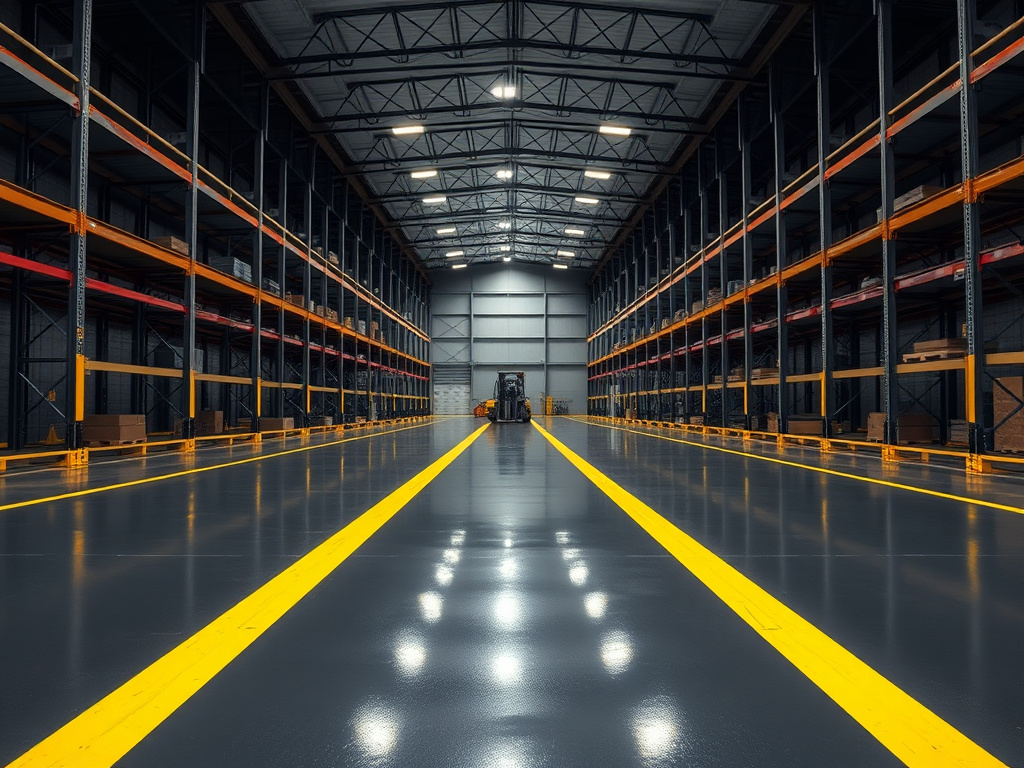
Commercial & Industrial · Statewide
Warehouse & Industrial Floor Coatings in Arizona
Seamless polyurea concrete coating systems for distribution centers, plants, hangars and shops from Phoenix to Tucson — spec'd to your real duty cycle, installed in phased windows, back under forklifts the next shift.
25–125
Mils by duty cycle
Next Shift
Return to service
ASTM F1869
Moisture testing
Phased
Bay-by-bay install
Specify to the duty cycle
The wrong question is which product. The right question is what runs across it.
Nearly every failed industrial floor we are called to look at in the Valley failed because it was specified as a product rather than as a system matched to a duty cycle. A 20-mil roller-applied film is a perfectly good floor in a climate-controlled electronics assembly room in Chandler. Put the identical film in a Phoenix cross-dock where steel-wheeled pallet jacks pivot under load at the dock plate and it will be down to bare concrete in the turn radius inside a year.
So the survey comes first. What wheels run on this floor, and how many hours a day? Where do loads get dropped rather than set down? Which lanes see hydraulic fluid, battery acid, coolant or food acids, and how long does a spill sit before someone gets to it? Is there thermal shock at a wash-down station or a refrigerated dock? Are there rack legs and dock plates concentrating point loads into a few square inches? Those answers set the film build, the aggregate, the primer and the joint treatment — in that order.
Polyurea earns its place in a facility on one specific property: cure speed. The material gels in seconds and reaches serviceable hardness in hours, which converts a coating project from a week-long shutdown into a weekend or an overnight. For a Tucson distribution operation running two shifts, the difference between five days of lost floor and one is not a line item on the coating quote — it dwarfs the coating quote. Everything else the material brings, the abrasion resistance, the 300 to 400 percent elongation over a moving slab, the −30 to 250°F service range, is upside on top of that.
Facilities across Mesa, Gilbert, Scottsdale and Flagstaff run different exposures again — high-country buildings deal with de-icing salt tracked in on truck tires, which is a chloride attack problem rather than an abrasion problem, and gets a different primer strategy entirely.
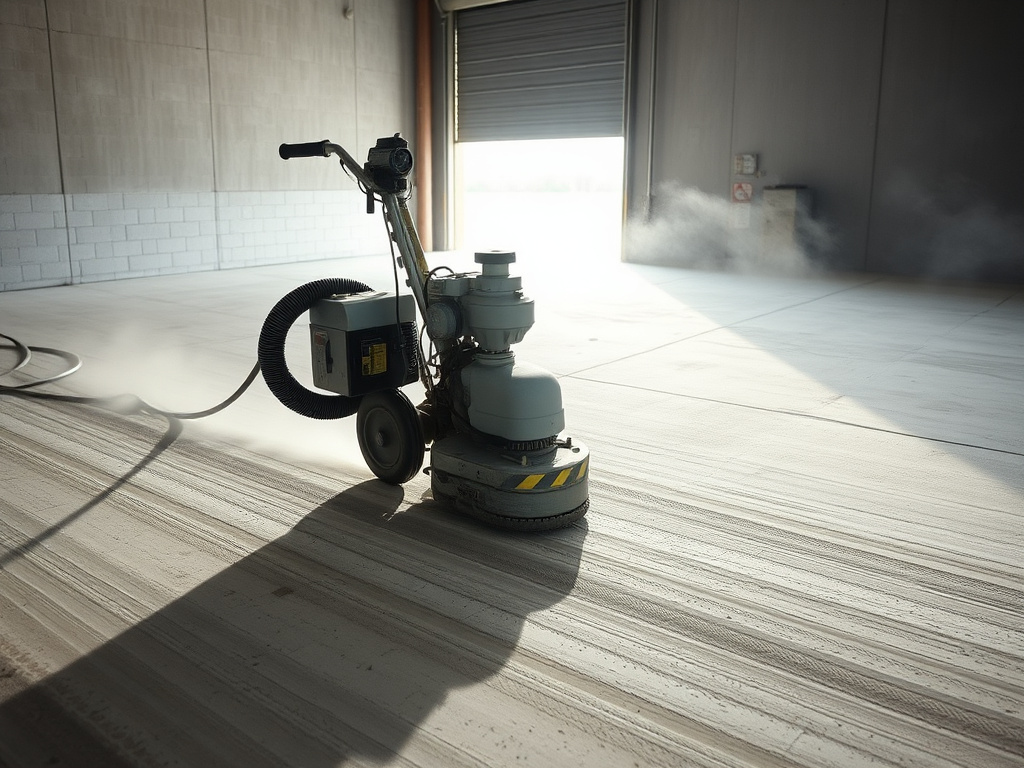
Facilities we coat
Same material family, eight different build sheets. The survey decides which one your slab gets.
- ✓Distribution and cross-dock warehouses
- ✓Manufacturing and fabrication plants
- ✓Aviation hangars, MRO bays and fleet shops
- ✓Auto dealerships, service bays and wash bays
- ✓Breweries, food processing and cold storage
- ✓Mining support, agriculture and utility facilities
Build sheet
Film build, profile and joints — the three lines that decide the outcome
Film build is the headline number and the one most commonly shaved on a low bid. Every mil of thickness is material cost and labor, so a contractor who wants to come in under the field quotes 20 mils where the duty cycle calls for 60 and lets the facility discover the difference eighteen months later. Ask for total dry film thickness in writing, and ask how it will be verified. Wet film gauges during application and a post-install measurement are both cheap and both settle the question.
Profile is the number nobody asks about and the one that actually governs adhesion. The ICRI concrete surface profile scale runs from CSP 1, roughly the texture of an acid etch, to CSP 9, which resembles heavy scarification. Thin roller-applied films want CSP 2 to 3, achievable with a diamond grinder. Anything at 60 mils and above wants CSP 4 to 5 from a shot blaster, because a high-build system needs a deeper mechanical key to resist the shear a steel wheel puts into it. Matching profile to build is basic trade practice and it is skipped constantly.
Joints are where industrial floors actually break. A control joint is a deliberately induced crack, and it will keep moving after the coating goes down. If a rigid, high-build system bridges it, the joint telegraphs through as a ragged crack within a season. Worse, joint edges spall under wheel impact, and a spalled joint in a forklift lane becomes a maintenance problem long before the field coating wears. We saw-clean joints, rebuild the edges with a rigid semi-rigid filler that supports the arris under wheel load, and honor genuine expansion joints through the coating with a flexible detail.
Cove base, trench drains, equipment pads and dock aprons each get their own detail. In food, beverage and pharmaceutical spaces the cove is integral and radiused for wash-down and inspection, tying into the same sanitary approach we use on commercial kitchen floors.
| Light duty (retail, storage, electric cushion tire) | 25–40 mils · pigmented polyurea + aliphatic topcoat, smooth to lightly textured |
|---|---|
| Medium duty (distribution, pallet jack, mixed traffic) | 40–60 mils · polyurea broadcast system with graded quartz or aluminum oxide |
| Heavy duty (manufacturing, steel wheel, impact) | 60–125 mils · double-broadcast quartz or troweled high-build with armored joints |
| Surface profile | ICRI CSP 3 for thin film; CSP 4–5 shot blast for 60 mils and above |
| Moisture limit before mitigation | 3 lb/1,000 sq ft/24 hr (ASTM F1869) or 85% internal RH (ASTM F2170) |
| Compressive strength | Filled systems typically exceed 10,000 psi — above the slab beneath them |
| Chemical exposure | Hydraulic fluid, diesel, battery acid, coolants, food acids, common solvents, de-icers |
| Service temperature | −30°F to 250°F continuous; thermal-shock tolerant at wash-down and dock lines |
| Return to service | Foot traffic 3–6 hours · forklift traffic 24 hours · full chemical cure 72 hours |
| Safety detail | Integrated aisle striping, hazard banding, cove base, trench and drain detailing, ESD systems on request |
Build selection is set by the duty-cycle survey, not by square footage. Every project ships with a written build sheet before mobilization.
Project sequence
Five stages, scheduled around your operation rather than ours
Nothing here is unusual for a competent industrial applicator. What varies between contractors is how much of it actually gets done when the schedule tightens.
Survey & Test
Duty-cycle walkthrough, moisture vapor testing, adhesion pulls on existing systems, joint and crack mapping, drainage check.
Specify
Film build, aggregate, chemical exposure list, traction zones and striping layout written into a build sheet before mobilization.
Prep
Shot blast to CSP 4–5 for high-build systems or diamond grind to CSP 3 for thinner films. Joints saw-cleaned and armored.
Install
Plural-component polyurea sprayed or troweled at spec thickness, quartz broadcast where required, wet film logged by section.
Verify & Release
Thickness and adhesion verification, striping and cove detail, then the bay goes back to operations — usually the next shift.
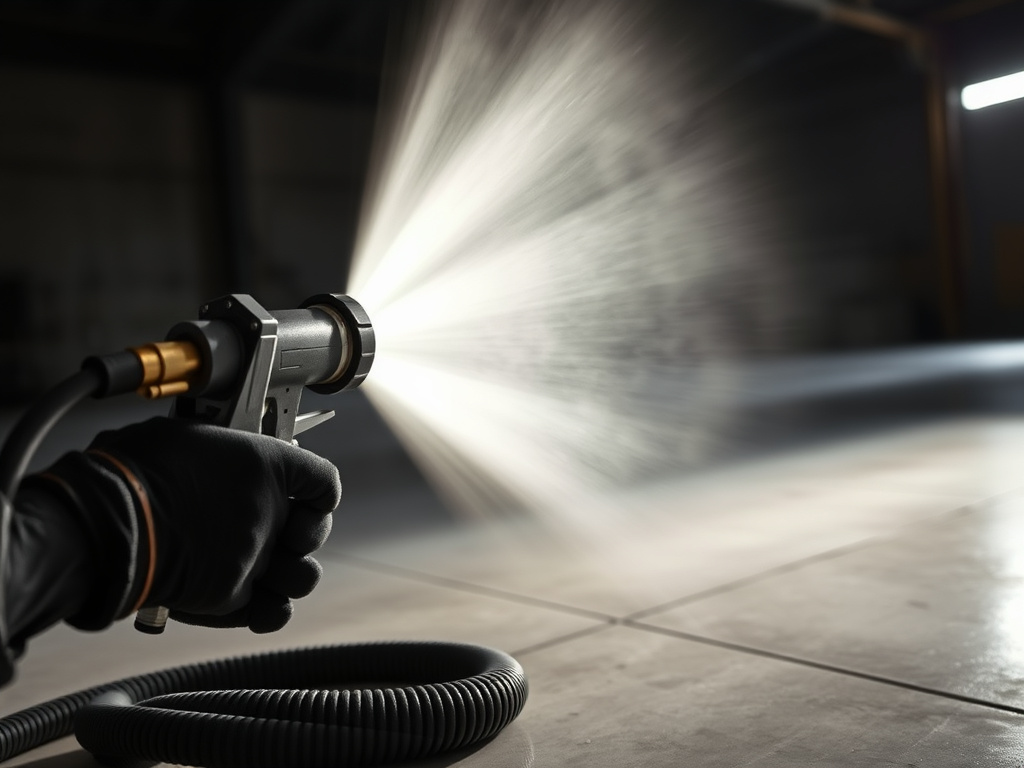
Downtime is the real cost
The coating is a line item. The floor being out of service is the actual expense.
Every scheduling decision on an industrial job traces back to cure chemistry. Fast cure is not a convenience feature here — it is the reason the project is affordable at all.
Bay by Bay
Phased installs
We section the floor, coat one area at a time behind temporary barricade, and hand it back before opening the next. Racking gets shifted rather than emptied, and the facility keeps running at reduced throughput instead of stopping.
Overnight
Shutdown windows
A single-shift operation can hand us the floor at 6 p.m. and take it back at 6 a.m. Prep the evening before, coat overnight, release in the morning. Epoxy cannot do this at any price; the chemistry will not allow it.
72 Hr
Full chemical cure
Foot traffic returns in three to six hours and forklifts at twenty-four, but full crosslink density and maximum chemical resistance arrive at about seventy-two. We tell you which activities to hold back during that window instead of pretending it does not exist.
Safety & wayfinding
Striping that is part of the floor, not painted on top of it
Tape peels. Traffic paint scuffs off under a pallet jack in a season and then gets repainted, badly, by whoever has a free afternoon. Because a polyurea system is built in layers, aisle markings, pedestrian walkways, equipment footprints and hazard banding can be laid into the build and sealed under the topcoat, where nothing short of grinding will remove them.
We lay out the plan with your safety lead before mobilization: traffic aisle widths, pedestrian crossings, eyewash and electrical panel clearances, fire equipment footprints, and any color coding your operation already uses. Contrast matters more than color choice — a yellow lane on a light grey field reads from across a 200,000-square-foot building, while the same yellow on a tan field disappears under sodium lighting.
Traction is zoned the same way. Racking aisles stay relatively smooth because cleanability and scrubber access matter more than grip on a dry floor. Dock aprons, ramps, wash bays and any lane where hydraulic fluid or condensate collects get an aggressive broadcast. A single traction spec across a whole building is always wrong somewhere.
Procurement
What we hand a facility manager or general contractor
Industrial work is a documentation exercise as much as an application one. Everything below is standard, not an upcharge.
- ✓Written build sheet: film thickness, profile, aggregate, primer and topcoat by zone
- ✓Product data and safety data sheets for every component on the truck
- ✓Moisture test results (ASTM F1869 or F2170) with the bid, not after mobilization
- ✓Adhesion pull-test data on any existing system being overcoated
- ✓On-site mock-up panel where the specification calls for one
- ✓Wet film logs by section and a closeout thickness report
- ✓Phasing plan with barricade layout, ventilation and access coordination
- ✓Written system warranty with the exclusions stated plainly
Comparing systems? Start with polyurea vs epoxy — including the cases where epoxy is genuinely the better commercial choice.
Service life
Ten years or more under traffic, if the maintenance plan is real
An industrial floor does not wear evenly. It wears in three lanes and at one dock door, and a facility that recoats those zones on schedule never faces a full reinstall.
Request a facility walkthroughAutoscrubbers with the correct pad and a neutral cleaner do almost all the work. The failure mode to watch for is grit: Arizona facilities track an extraordinary amount of fine silica in from the yard, and that grit under a steel wheel is a lapping compound. Sweep and scrub on a real interval, keep dock aprons clean, and the wear curve flattens dramatically.
We recommend an annual walk with the facility team. We look at the three or four zones that actually take load, measure remaining film where it matters, check joint fillers for edge spalling, and flag anything that wants attention in the next twelve to eighteen months. A recoat pass over a worn lane is a weekend visit. A floor allowed to wear through to concrete in the lane is a re-prep and a full reinstall of that section.
We work facilities across the state — Phoenix and the West Valley, Mesa, Chandler and Gilbert in the East Valley, Tucson and the southern corridor, and up into Flagstaff and Prescott. See where we mobilize, read the technical write-ups on the blog, or check the full FAQ before you write your specification.
How thick should an industrial floor coating be for forklift traffic?
+
It depends on the wheel, not the truck weight. Cushion-tire electric forklifts on a smooth slab are comfortable at 25–40 mils of total build. Pneumatic and steel-wheel traffic, pallet jacks dragging loaded skids, and any area where a load gets dropped need 60–125 mils, which means a broadcast quartz or troweled build rather than a roller-applied film. Point loading from rack legs and dock plates is a separate calculation again — those areas get localized reinforcement regardless of what the field build is.
How much downtime does a warehouse floor coating require?
+
Far less than epoxy, and that is usually the deciding factor. Polyurea gels in seconds and reaches foot-traffic hardness within a few hours, so a bay coated Saturday morning takes racking back Sunday and forklifts Monday. An epoxy system on the same bay wants five to seven days of cure before heavy traffic. We phase distribution floors bay by bay, coat around fixed racking, and work night and weekend windows so the facility never goes fully offline.
What is moisture vapor transmission and why does it matter on an Arizona slab?
+
Concrete on grade transmits water vapor upward from the soil. Many older Phoenix and Tucson industrial slabs were poured with no vapor retarder, and during monsoon season the subgrade wets and drives four to eight pounds of vapor per 1,000 square feet per 24 hours through the slab. A low-permeability coating over that builds osmotic pressure at the bond line and blisters or delaminates. We test with ASTM F1869 calcium chloride or ASTM F2170 in-situ relative humidity probes before quoting, and install a mitigation primer where the numbers demand it. A bid with no moisture testing line item is a bid with an unpriced risk in it.
Can you coat over an existing epoxy or urethane warehouse floor?
+
Only after adhesion testing. We pull tensile dollies in a representative grid across the floor; if the existing system fails cohesively in the concrete at a healthy value it is well bonded and can be mechanically abraded and overcoated. If it fails at the bond line, or if there is any evidence it went down over an acid-etched or sealed slab, it comes off. Overcoating a failing system just buys you a more expensive version of the same failure.
Do you provide submittals and thickness verification for a general contractor?
+
Yes. We supply product data sheets, safety data sheets, application and substrate-prep procedures, and a mock-up where the specification calls for one. During install we log wet film thickness readings by section and pull adhesion tests on request, then close out with a thickness and adhesion report. Facility managers and general contractors in Phoenix, Tucson and Chandler get the same documentation package whether the job is 2,000 or 200,000 square feet.
What about safety striping, aisle marking and slip resistance?
+
All of it goes into the system rather than on top of it. Traffic aisles, pedestrian walkways, equipment footprints and hazard zones are laid out in color and integrated into the build so they cannot be scuffed off by a pallet jack the way tape and painted stripes are. Slip resistance is set per zone — smooth in the racking aisles where cleanability matters, aggressive broadcast at dock aprons, ramps, wash-down areas and anywhere hydraulic fluid or condensate collects.
Services
Other systems for Arizona facilities
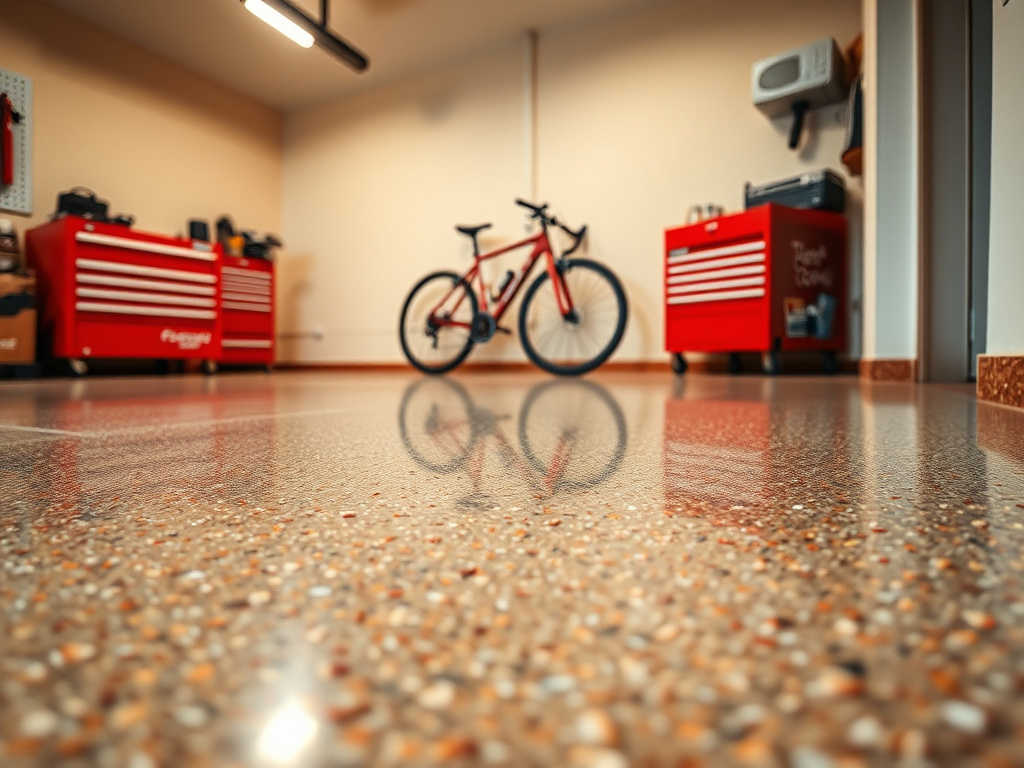
Garage Floor Coatings
One-day polyaspartic flake systems that shrug off hot-tire pickup, monsoon grit and 160°F slab temperatures.
Explore this system →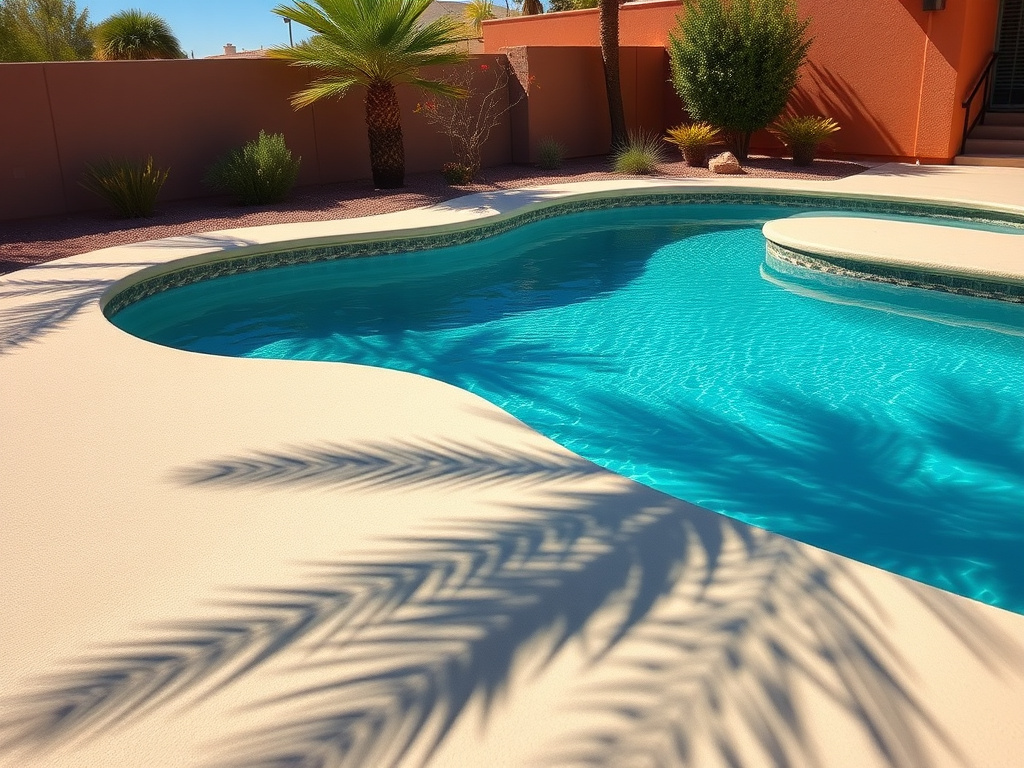
Patio & Pool Deck Coatings
Textured, heat-reflective cool-deck finishes that stay barefoot-friendly through a Phoenix July.
Explore this system →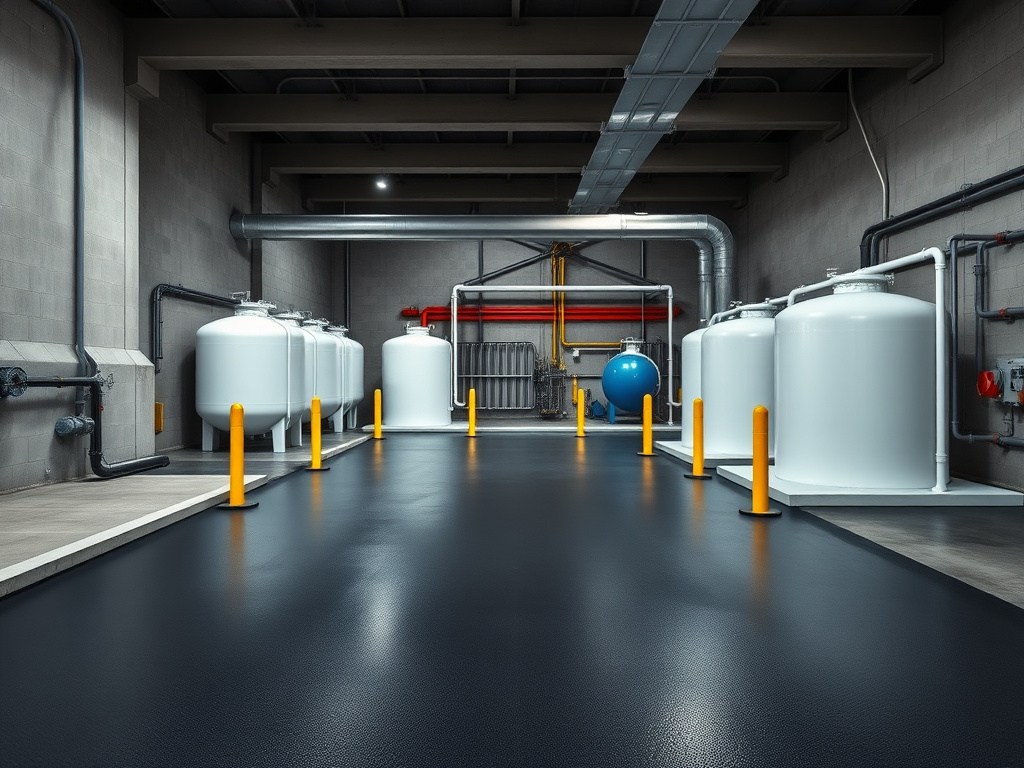
Secondary Containment & Tank Coatings
Monolithic chemical-resistant linings for berms, sumps, trenches and above-ground tank exteriors.
Explore this system →Get a free facility floor quote
Send square footage, duty cycle and your shutdown window. We will survey the slab, test it, and return a written build sheet with the number.