Material comparison · No sales pitch
Polyurea vs Epoxy: The Honest Technical Comparison
Two different polymer families, two different failure modes, two different price points. Here is what actually separates them — including the cases where epoxy is the smarter buy.
300–400%
Polyurea elongation
1–5%
Epoxy elongation
1 Day
Polyurea return to service
5–7 Days
Epoxy full cure
Start with the polymer
An elastomer and a rigid thermoset are not competitors — they are different tools
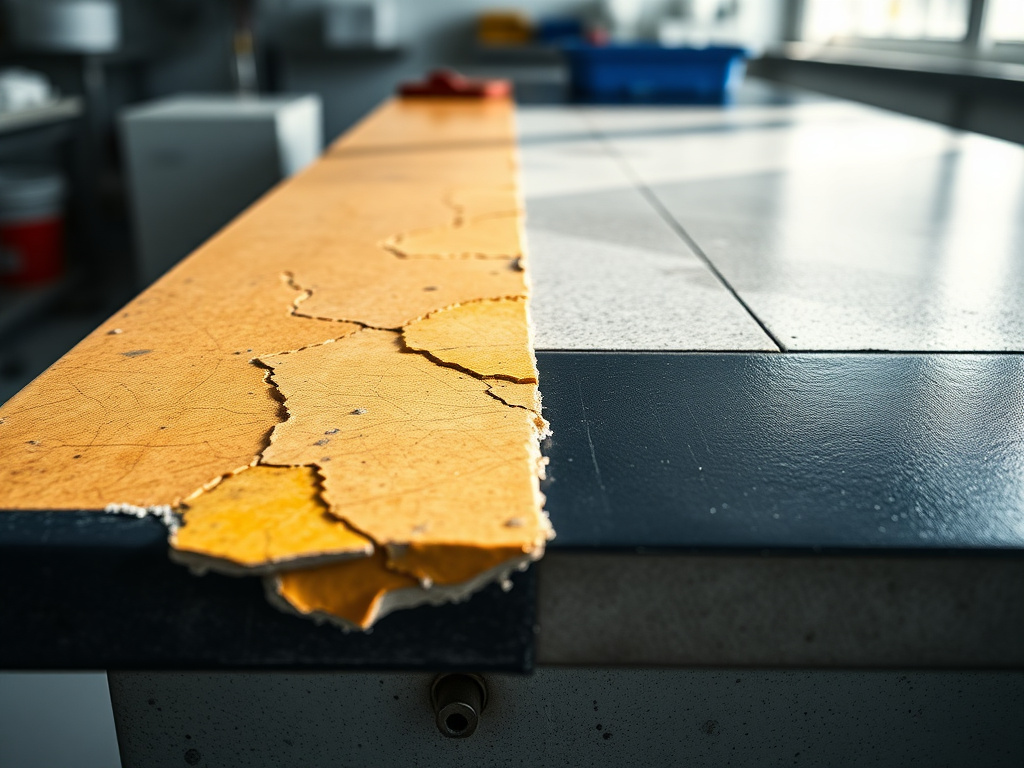
Epoxy is a rigid thermoset. Two components — an epoxide resin and an amine hardener — cross-link into a dense, glassy network. That network is hard, chemically resistant and inexpensive, and it has essentially no ability to stretch. Somewhere between one and five percent elongation before it fractures. When epoxy meets a force it cannot resist, it does not deform; it breaks.
Polyurea is an elastomer. It forms when an isocyanate meets an amine-terminated resin, and the reaction is extremely fast — a matter of seconds. The resulting polymer has long flexible segments between its hard blocks, so it stretches three to four times its own length before failing and then returns. When polyurea meets a force it cannot resist, it deforms and recovers.
Everything downstream flows from that single structural difference. Crack bridging, impact behavior, hot-tire performance, thermal cycling tolerance, cure speed, cost and the equipment required to install it are all consequences of elastomer versus thermoset. Understanding that one distinction is enough to predict how each material will behave in almost any situation you can describe.
The practical version: epoxy is harder, cheaper and easier to install. Polyurea is tougher, faster, far more UV- and heat-stable, and more expensive to buy and to apply. Neither statement is marketing. Both are on the technical data sheets.
Where polyaspartic fits in
Most of what the market calls a “polyurea garage floor” is actually a hybrid: a polyurea or polyaspartic base coat, a full broadcast of decorative flake, and an aliphatic polyaspartic topcoat. Polyaspartic is chemically a polyurea, slowed to a workable pot life and made UV stable — which is why it can be hand-applied and still return the floor to service the same day.
- ✓Polyaspartic = aliphatic polyurea with an aspartic ester co-reactant
- ✓Pot life 20–45 minutes instead of 5–30 seconds
- ✓UV stable, so it holds color under direct Arizona sun
Side by side
Thirteen properties, compared without spin
Figures below are typical ranges from published technical data sheets across the category, not from any single manufacturer. Individual products vary — always ask a bidder for the actual data sheet of the actual product they intend to install.
| Property | Polyurea / Polyaspartic | Epoxy |
|---|---|---|
| Chemistry | Two-component elastomer — isocyanate plus amine or aspartic co-reactant. Flexible polymer network. | Two-component rigid thermoset — epoxide resin plus amine hardener. Cross-linked and glassy. |
| Gel / working time | 5–30 seconds for pure polyurea; 20–45 minutes for polyaspartic. Fast, and unforgiving. | 20–40 minutes pot life, with hours of open time. Very forgiving to work with. |
| Return to service | Foot traffic in hours, vehicles typically in 24 hours. Genuine single-day installs. | Foot traffic 24–48 hours, vehicles and chemical service 5–7 days. |
| Elongation at break | Roughly 300–400%. Bridges hairline cracks and slab movement. | Roughly 1–5%. Cracks along substrate movement rather than spanning it. |
| Glass transition temp | Well above typical slab temperature. Surface does not soften in summer heat. | Comparatively low. Softens as slab temperature climbs — the hot-tire mechanism. |
| UV stability | Aromatic grades amber and chalk; aliphatic and polyaspartic grades hold color for years. | Aromatic by nature. Ambers and chalks in direct sun regardless of grade or pigment. |
| Abrasion & impact | Absorbs impact energy; excellent abrasion resistance. Dents rather than chips. | Harder surface, higher compressive strength, but brittle. Chips and spalls under impact. |
| Chemical resistance | Broad resistance to fuels, salts, acids and sanitizers; excellent in containment service. | Genuinely strong against many solvents and acids — often equal or better in static immersion. |
| Moisture tolerance | Fast cure makes it less tolerant of vapor drive; a mitigating primer is mandatory when testing says so. | Some 100% solids and moisture-tolerant epoxy primers handle vapor drive well, and are often used under polyurea. |
| Application | Heated plural-component proportioner at high pressure, trained applicator. Not a DIY material. | Roller, squeegee or notched trowel. Accessible to trained crews and to homeowners. |
| Build per coat | Thin per pass for polyaspartic; very high build possible for sprayed polyurea in a single pass. | High build in one pass, self-leveling, fills pinholes and minor imperfections. |
| Relative material cost | Higher — commonly 30–60% more than an equivalent epoxy build, before labor. | Lower material cost and lower equipment overhead. The budget option, honestly. |
| Realistic service life | 15–20 years residential, 10+ years in heavy industrial traffic when properly prepped. | 5–10 years indoors and shaded; considerably less in direct sun or hot-tire service. |
How each one fails
Materials are best judged by their failure modes, not their brochures
Every coating fails eventually. What matters is whether the way it fails is one your building will actually experience.
Hot-tire pickup
Epoxy's characteristic Arizona failure. A tire at 150°F parks on a 140°F slab, the coating softens above its glass transition point, the cooling rubber contracts and lifts a patch. Polyurea's transition temperature sits well above slab temperature, so the surface never softens.
UV ambering and chalk
Both aromatic epoxy and aromatic polyurea degrade under ultraviolet light — first a yellow shift, then a powdery chalk layer. The difference is that polyurea has an aliphatic version that solves it outright. Epoxy does not; it needs a different chemistry on top.
Crack telegraphing
A hairline in the slab reappears through a rigid coating within a season because the coating cannot stretch across it. An elastomeric membrane at 300 percent elongation spans that movement instead of splitting along it.
Impact chipping
Drop a hitch ball or a hotel pan. Hard, brittle epoxy chips and exposes a bare edge that then propagates. A tough elastomer deforms and recovers, or at worst dents without exposing substrate.
Moisture blistering
This one is not chemistry-specific — it is a prep failure. Vapor moving up through a slab pushes any coating off, polyurea and epoxy alike. The fix is testing and a mitigating primer, and it is where a moisture-tolerant epoxy primer under a polyurea system is often the right hybrid.
Delamination from bad prep
The most common failure in the entire trade, and it belongs to neither material. An acid-etched or power-washed-only slab gives no mechanical key. The coating peels in sheets and everyone blames the product.
The section most coating companies skip
Where epoxy genuinely wins — and we will tell you so on site
We install polyurea for a living. That does not make epoxy a bad material; it makes it a material with a narrower correct application. Here are the five situations where it is the better technical and financial answer, and where recommending polyurea would simply be taking your money.
1. Interior, shaded, climate-controlled slabs
If a floor never sees ultraviolet light and never sees a hot tire, the two mechanisms that kill epoxy in Arizona simply do not apply. An interior showroom, a shop with no vehicle traffic, a conditioned storage room — epoxy will serve there for a decade and cost less doing it.
2. High build in a single pass
Self-leveling epoxy will lay down 60 to 125 mils in one application and flow out flat, filling pinholes and minor imperfections as it goes. Fast-set polyurea cannot do that; it gels before it can level. Where a slab needs a thick, smooth, monolithic layer built quickly, epoxy is the right tool.
3. Lower material cost
On a straightforward interior slab with no heat, UV or downtime pressure, epoxy is meaningfully cheaper per square foot and needs no heated plural-component equipment. If the failure mechanisms are absent, paying the polyurea difference buys resistance to problems the floor will never encounter.
4. Long working time and DIY access
A 20 to 40 minute pot life and hours of open time make epoxy genuinely workable by a careful non-specialist. Polyurea's five-to-thirty-second gel is not forgiving of anything. If a homeowner wants to do the work themselves, epoxy is the only realistic option of the two.
5. Moisture-mitigating primers
Some of the best vapor-barrier primers on the market are epoxies, and we specify them ourselves underneath polyurea systems on slabs with elevated vapor drive. This is the clearest case of the two materials being complementary rather than competitive.
6. Static chemical immersion
In certain continuous immersion services — particular solvents and concentrated acids in tanks and pits — a correctly selected novolac epoxy outperforms polyurea. Containment specification is product-specific, and we choose on the chemistry stored, not on brand loyalty.
What all six have in common is the absence of the two conditions that define an Arizona exterior or semi-exterior slab: direct ultraviolet exposure and extreme surface temperature. Remove those, and epoxy’s weaknesses stop mattering while its strengths remain. Add them back — a garage with the door open, a pool deck, a driveway apron, a roof or tank exterior — and the comparison stops being close.
Cost, honestly
Polyurea costs more per square foot. That is not the whole number.
Material for a polyurea or polyaspartic system typically runs 30 to 60 percent above an equivalent epoxy build, and the equipment overhead is higher still — a heated plural-component proportioner, a properly maintained spray gun, and an applicator trained on both. Anyone who tells you polyurea is cheaper up front is not quoting polyurea.
What changes the arithmetic is everything that is not material. On a residential garage, the labor difference is small and the service-life difference is large: a properly built polyurea system routinely runs 15 to 20 years in Arizona conditions, while epoxy in the same garage may need redoing in five to eight. Two epoxy installs cost more than one polyurea install, and the second one includes grinding the first one off.
On a commercial floor the calculation is not even close, because the dominant cost is not the coating — it is the downtime. Five to seven days of epoxy cure in a distribution center, a production kitchen or a plant is a week of lost throughput. Fast-cure chemistry compresses that to a weekend or a series of nights. We have quoted facilities where the material difference was a rounding error against a single day of lost operation.
The dishonest comparison is a per-square-foot number with no specification attached. Mil thickness, prep method, number of coats and topcoat chemistry move the price far more than the resin family does. A cheap polyurea bid usually means a thin single coat over an under-prepared slab, and that will fail faster than a well-built epoxy.

What installing each one requires
The equipment gap is why bad polyurea jobs exist
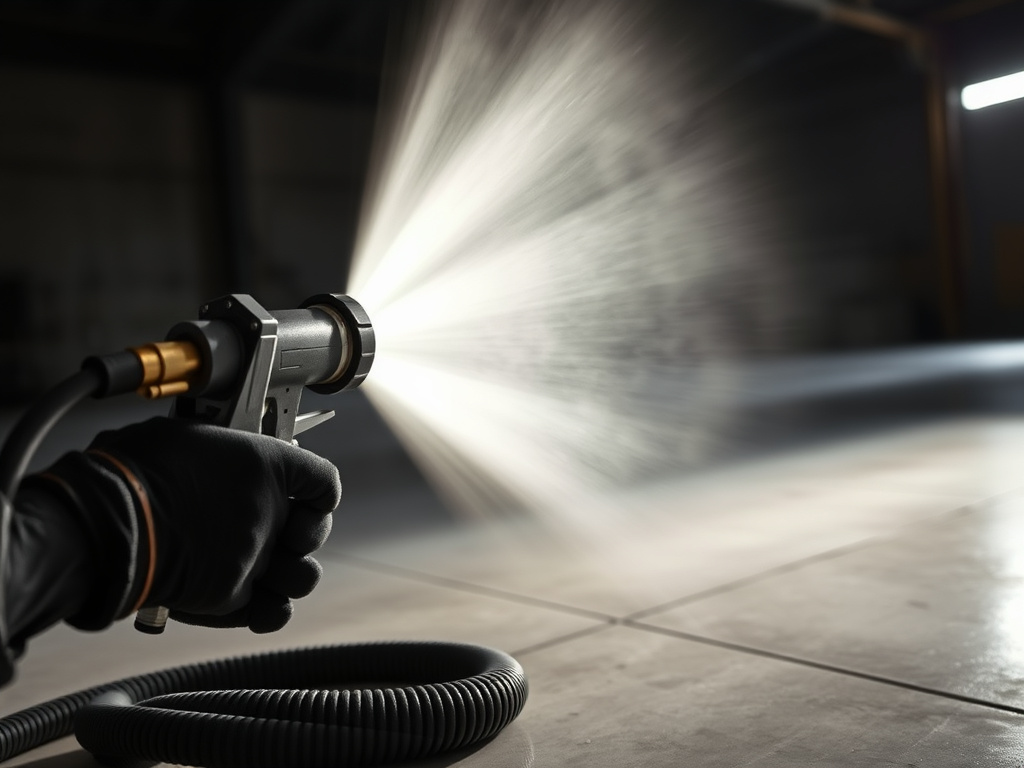
Pure polyurea is sprayed through a heated plural-component proportioner that meters two components at roughly a one-to-one ratio, heats them to specification, and delivers them at high pressure to an impingement-mix gun. The two streams meet and react inside the gun. If the ratio drifts, the heat is wrong or the pressure drops, the chemistry is off and no amount of careful technique fixes it afterwards.
That equipment is expensive and it demands maintenance and training. Which is why a genuine polyurea contractor looks different from a roller-and-bucket operation, and why “polyurea” on a proposal deserves a follow-up question about what is actually being sprayed and with what.
Epoxy needs a mixing paddle, a squeegee and a roller. That accessibility is a real advantage in the right context, and it is also why the market is flooded with low-bid epoxy work over unprepared slabs.
1:1
Component ratio
Metered continuously by the proportioner. Drift here changes the polymer, not just the finish.
150°F
Component preheat
Both sides heated before they reach the gun so viscosity and reactivity are correct.
2,000 psi
Delivery pressure
High-pressure impingement mixing — the two streams collide and react inside the gun head.
CSP 2–3
Required profile
Mechanical profile the coating keys into. An etched slab cannot produce it.
The skeptical questions
Including the ones that make us look worse
These are the questions Arizona searchers actually type. We answer them the same way on the phone at 844-967-5247 as we do here.
What are the negatives of polyurea?
+
There are four real ones, and anyone who tells you otherwise is selling. First, cost: material runs meaningfully higher per square foot than epoxy, typically 30 to 60 percent more on an equivalent build. Second, it is not a do-it-yourself material — pure polyurea gels in five to thirty seconds and requires a heated, plural-component proportioner and a trained sprayer, so a bad applicator cannot be rescued by working slowly. Third, it is unforgiving of substrate error; because it cures so fast, it locks in whatever contamination, moisture or poor profile is underneath rather than giving you time to notice. Fourth, low-viscosity fast-set polyurea does not self-level or fill pinholes the way a slow epoxy does, so surface imperfections need to be addressed in prep rather than flooded over.
Is polyurea stronger than epoxy?
+
It depends entirely on which kind of strength you mean, and this is where most marketing goes wrong. Epoxy is harder and has higher compressive strength — it will resist a static point load better. Polyurea is dramatically tougher, meaning it absorbs energy instead of transmitting it: elongation typically 300 to 400 percent versus epoxy's 1 to 5 percent, far higher tensile elongation at break, and much better impact and abrasion resistance in practice. A dropped wrench chips epoxy and dents polyurea. A slab that moves cracks epoxy and stretches polyurea. For floors, toughness matters more than hardness, which is why polyurea generally outlasts epoxy in the field despite being the softer material on paper.
What does polyurea not stick to?
+
Polyurea will not bond reliably to anything with a release agent, an oily or waxy surface, a silicone residue, or an un-abraded glossy plastic such as polyethylene or polypropylene — the same properties that make those plastics useful make them nearly impossible to coat. It also will not bond to a damp or vapor-driving slab without a moisture-mitigating primer, to a smooth troweled slab that has not been mechanically profiled, or to an existing coating that is itself delaminating. On concrete the answer is almost always the same: it sticks to a clean, dry, mechanically profiled surface and nothing else. Acid etching does not produce that surface.
What is the downside of epoxy flooring?
+
Four things, and in Arizona the first two dominate. Epoxy is a rigid thermoset with very low elongation, so when the slab moves — and every slab moves — it cracks along the movement instead of bridging it. It has a relatively low glass transition temperature, meaning it softens as the slab heats, which is the direct mechanism behind hot-tire pickup. It is aromatic, so ultraviolet light degrades it: it ambers, then chalks, and a white epoxy in direct sun will not stay white. And it cures slowly, taking five to seven days to reach full chemical and thermal service, which for a commercial facility is a week of lost operation.
How does hot-tire pickup actually work?
+
A tire that has been running on I-10 in August comes off the road at 130 to 160°F and parks on a slab already sitting near 140°F. Two things then happen at once. The hot rubber plasticizes slightly and grabs the coating surface, and the coating itself softens because it is now above or near its glass transition temperature. As the tire cools it contracts and shrinks against the floor. If the coating's bond to the concrete is weaker than the momentary bond between rubber and coating, the coating loses — and it lifts in the distinctive dinner-plate-sized patch under the tire footprint. Polyurea and polyaspartic chemistry resists this because their glass transition temperature is far above the slab temperature, so the surface never softens in the first place.
Is polyaspartic the same thing as polyurea?
+
Polyaspartic is a subset of polyurea — specifically an aliphatic polyurea made with an aspartic ester co-reactant that slows the reaction down to a workable pot life of twenty to forty-five minutes instead of seconds. That single change is enormous practically: it can be roller- or squeegee-applied by hand, it stays UV stable because it is aliphatic, and it still cures fast enough to return a floor to service the same day. In real installations the two are usually used together — a fast-set polyurea or a broadcast base coat for build and flexibility, with a polyaspartic topcoat for UV stability and cleanability.
Can polyurea be installed over an existing epoxy floor?
+
Sometimes, and only after testing. If the existing epoxy is fully bonded, passes an adhesion pull test and can be mechanically abraded to a uniform profile, a recoat is legitimate and saves real money. If it is delaminating anywhere, if it was installed over an acid-etched slab, or if there is moisture vapor moving through the slab, it has to come off — because the new system will only ever be as strong as the weakest layer beneath it. We test before we quote, not after.
Which one should I actually buy for an Arizona garage?
+
For a garage that sees vehicles, direct sun through an open door, and 140°F-plus summer slab temperatures, a polyurea base with a polyaspartic topcoat is the technically correct answer, and it is what we install. For a fully interior, shaded, climate-controlled slab that will never see a hot tire — a basement-equivalent space, an indoor showroom, a shop with no vehicle traffic — a good high-build epoxy is a legitimate choice and it will cost you less. The question is not which material is better. It is which one matches your thermal and UV exposure.
Not sure which system your slab needs?
Tell us the space, the exposure and the downtime you can tolerate. If epoxy is the right answer for your project, we will say so.