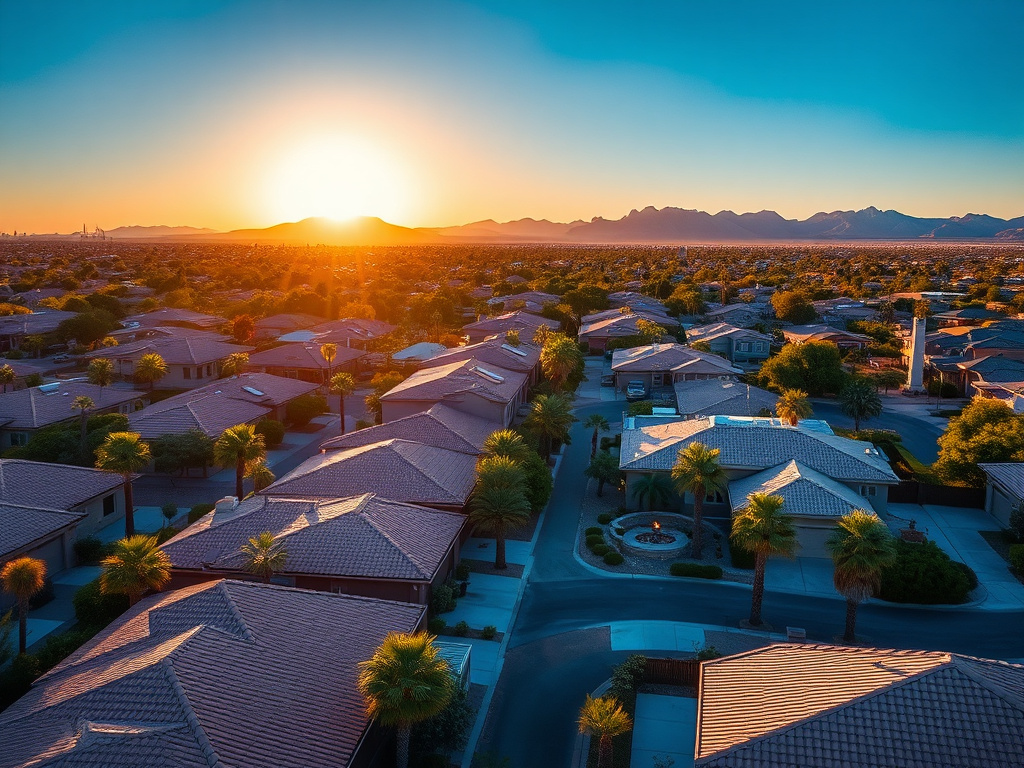
Arizona statewide · Three climate zones
We Coat All Of Arizona, Not Just The Valley
Low desert, southern corridor and high country punish a floor in three completely different ways. Same material family, three genuinely different specifications — and one crew that writes all three.
3
Distinct climate zones
7,000 ft
Elevation range served
Statewide
Crew deployment
1 Spec
Standard across sites
Why this page is technical, not a city list
Arizona spans 7,000 feet of elevation. A floor specification cannot ignore that.
Most coating companies operating in this state are Phoenix companies. That is not a criticism — the Valley holds most of the population and most of the work. But it does mean that the standard Arizona floor specification is really a low-desert specification, written for heat and ultraviolet, and then applied unchanged to slabs in Tucson and Flagstaff where the governing stresses are entirely different.
Drive from Yuma at 140 feet above sea level to Flagstaff at nearly 7,000 in a single day and you pass through conditions that would be three separate states anywhere else. Yuma runs a 110-degree summer with almost no freezing. Tucson gets roughly half its annual rainfall inside a six-week monsoon. Flagstaff averages substantial annual snowfall and cycles across the freezing point again and again from November through March.
Concrete responds to each of those differently, and so must the coating bonded to it. The chemistry family stays the same — a two-component elastomer with a UV-stable topcoat — but the primer, the build thickness, the elongation target, the topcoat selection and the installation calendar all move.
That is the whole argument for a statewide contractor. Not that we will drive further, but that we write the specification differently when the elevation changes. If a bid for your Prescott garage is identical to the bid for a Chandler garage, ask what in it accounts for freeze-thaw and road salt.
What changes between zones
Four variables carry almost all the difference. Everything else about the install — grinding, crack repair, broadcast technique, edge detailing — stays constant statewide.
- ✓Primer chemistry — standard, moisture-mitigating or low-temperature cure
- ✓Elongation target — heat headroom in the desert, movement tolerance up north
- ✓Topcoat selection — UV load versus chloride and salt exposure
- ✓Installation calendar — substrate temperature governs the workable window
Zone 1 · Sonoran low desert
Phoenix metro — where heat and ultraviolet decide everything
Elevation here runs roughly 1,000 to 1,600 feet, and the design problem is thermal and photochemical rather than structural. A west-facing garage slab in Gilbert routinely exceeds 140°F in July. A pool deck in Scottsdale takes ten hours of direct ultraviolet a day for five months straight. Neither of those is a comfort statistic — both are material-science thresholds, and they sit above where conventional epoxy chemistry stops behaving.
The consequence we see most often is hot-tire pickup. A vehicle comes off the freeway with tire surfaces at 150°F onto a slab already near 140°F, the coating softens above its glass transition point, and as the rubber cools and contracts it lifts a plate-sized patch of coating with it. It is not a workmanship failure and it is not bad luck. It is a specification that never had the thermal headroom for this valley.
So the Valley specification prioritizes a glass transition temperature well above realistic slab temperature, an aliphatic polyaspartic topcoat that will not amber under that ultraviolet load, and enough decorative flake to hide the dust that arrives with every haboob. Exterior work is scheduled early or moved to the cooler half of the year, because substrate temperature drives both working time and cure quality.
Communities we serve in this zone
Most requested systems here
Zone 2 · Southern corridor
Tucson to Yuma — where moisture, not heat, moves the coating
This corridor still gets punishing heat — Yuma is among the hottest inhabited places in the country — but the failure mode that actually decides jobs down here is different. Tucson and the surrounding communities have a deep stock of slabs poured decades before under-slab vapor retarders became routine, and southern Arizona's monsoon delivers a genuinely large fraction of the annual rainfall into the ground in a matter of weeks.
Water in the soil under a slab does not stay in the soil. Vapor pressure drives it upward through the concrete, and when it reaches a coating with low permeability it accumulates at the bond line until it pushes the coating off. The result looks exactly like an adhesion failure — dome-shaped blisters, a coating that peels cleanly with no concrete on the back — but the cause is hydrostatic, and grinding harder does not fix it.
Which is why every older slab in this zone gets tested rather than assumed. Calcium chloride or in-situ relative humidity probes, a look at the site drainage and the irrigation, and an honest read on any efflorescence already visible. Where the numbers require it, we install a moisture-mitigating primer before anything else goes down. Where the numbers are fine, we save the client that cost and say so.
There is a second regional factor worth naming: agricultural and industrial facilities across Yuma and Casa Grande run chemical and washdown exposures that Valley residential contractors rarely encounter, from fertilizer and fuel handling to produce processing floors that see continuous water.
Communities we serve in this zone
Most requested systems here
Zone 3 · High country
Flagstaff to Show Low — where the problem inverts completely
Above about 5,000 feet, everything the Valley specification optimizes for stops being the point. Flagstaff sits above 6,900 feet and takes real snowfall. Prescott, Payson and Show Low all cycle across freezing repeatedly through the winter. The dominant stress is no longer heat — it is expansion and contraction, repeated hundreds of times a season, plus chloride.
Freeze-thaw works on concrete from the inside. Water in the pore structure expands roughly nine percent as it freezes, and every cycle widens micro-cracks. A rigid coating bonded to a slab doing that will fracture along the movement. An elastomer at 300 to 400 percent elongation stretches over it. This is the single strongest technical argument for polyurea in high-country Arizona, and it is almost the opposite of the argument we make in Phoenix.
Then there is de-icing salt. Vehicles come off US 180 or I-17 carrying chloride brine and drop it onto the garage floor, where it sits in the melt water. Chlorides attack unprotected concrete and reinforcing steel and will find any pinhole in a coating. A seamless membrane with a salt-tolerant topcoat and properly detailed edges keeps that brine off the slab entirely — which is why a garage floor coating in Flagstaff is a durability investment rather than a cosmetic one.
The third difference is scheduling. Substrate temperature has to stay above the material's minimum for the entire cure window, overnight included, so the exterior season is shorter and primer selection changes. Low-temperature-cure chemistry, heated enclosures for interior work in winter, and a realistic calendar are all part of a high-country quote. A contractor who does not mention any of this has probably never worked above the rim.
Communities we serve in this zone
Most requested systems here
The three specifications, side by side
Same family, three different builds
This is the summary version of what changes and why. Use it to interrogate any bid you receive — including ours. A contractor who cannot explain which zone your property is in, and what that changes, is quoting from a template.
Statewide reach also means one standard across multi-site accounts: the same prep discipline, the same documented specification, and a repair years from now that matches what is already down.
| Low Desert — dominant stress | Slab surface temperature above 140°F, extreme UV load, hot-tire pickup |
|---|---|
| Low Desert — specification response | High glass-transition chemistry, aliphatic polyaspartic topcoat, heavier flake for heat-masking, early-morning exterior scheduling |
| Southern Corridor — dominant stress | Monsoon-driven moisture vapor through older, un-retardered slabs; efflorescence and blistering |
| Southern Corridor — specification response | Mandatory moisture testing, vapor-mitigating primer, breathable build where indicated, drainage correction before coating |
| High Country — dominant stress | Freeze-thaw cycling, chloride de-icing salt, short substrate-temperature window |
| High Country — specification response | Maximum-elongation elastomer, salt-tolerant topcoat, low-temperature primer chemistry, seasonal scheduling with heated cure where needed |
Multi-site & commercial accounts
One standard across every building you own
Arizona’s industrial map does not stop at Loop 303. The logistics corridor runs through Goodyear and Tolleson, semiconductor and supplier build-out has reshaped north Phoenix and Chandler, agriculture and food processing anchor Yuma and Casa Grande, and tourism and hospitality drive Sedona, Flagstaff and Prescott. A facility portfolio in this state frequently spans all three climate zones.
- ✓Restaurant and hospitality groups with locations in multiple zones
- ✓Distribution, logistics and cold storage across the Valley and southern corridor
- ✓Manufacturing, fabrication and process facilities with chemical exposure
- ✓Municipal water, wastewater and public works structures
- ✓Property managers and HOAs with common-area decks, ramps and garages
- ✓Fleet, service bay and equipment yard floors statewide
Service area questions
What people ask before booking outside the Valley
If your town is not listed above, call 844-967-5247 anyway — the zone map matters more than the city name, and we probably already work near you.
Polyurea vs epoxy, explainedDo you really work outside the Phoenix metro?
+
Yes, and it is the reason this page exists. Nearly every coating company ranking in Arizona search results is a Valley company with a Valley service radius, which leaves Tucson, Yuma, Flagstaff, Prescott, Sedona, Payson, Show Low, Sierra Vista and Casa Grande with almost no specialist option. We run crews statewide. Residential work outside the Valley is generally scheduled in batches so travel is shared across several jobs in the same week, and commercial work is scheduled to the facility's window regardless of where it sits.
Why would the specification change between Phoenix and Flagstaff?
+
Because the failure mechanisms invert. In Phoenix the dominant stresses are slab surface temperature above 140°F, relentless ultraviolet exposure and hot-tire pickup, so the priorities are a high glass transition temperature and an aliphatic UV-stable topcoat. In Flagstaff the dominant stresses are freeze-thaw cycling, chloride de-icing salt tracked in on vehicles, and a much shorter seasonal window in which substrate temperature allows a proper cure. That calls for maximum elongation to survive expansion cycles, salt-tolerant chemistry, and often a different primer entirely. A contractor quoting an identical build in both cities is quoting at least one of them wrong.
What makes southern Arizona slabs different?
+
Moisture, which surprises people in a desert. Tucson, Casa Grande, Yuma and Sierra Vista have significant stock of older slabs poured before under-slab vapor retarders were routine, and the summer monsoon drives ground moisture upward through them. That vapor pressure pushes coatings off from underneath — blisters that look like adhesion failure but are really hydrostatic. It is entirely manageable, but only if somebody actually tests for it. We run calcium chloride or relative humidity probes on any slab where the age, the site drainage or the visible efflorescence suggests vapor drive, and specify a mitigating primer when the numbers say so.
Is there a travel charge for jobs outside the Valley?
+
For most of the state, no separate travel line item — it is built into the scope. For genuinely remote locations, or for a single small residential job several hours out, we will either batch it with other work in that area or tell you plainly what the mobilization costs. What we will not do is quote a Valley price and then add travel after the grinder is already running.
When is the best time of year to coat a floor in Arizona?
+
It depends on which Arizona. In the low desert, interior work runs year round, while exterior pool decks, driveways and roofs are best scheduled October through April or worked early in the morning during summer, because substrate temperature affects both cure speed and working time. In the southern corridor the monsoon months compress exterior scheduling. In the high country the exterior window is roughly late spring through early fall, since substrate temperature has to stay above the material's minimum for the full cure period — including overnight. Interior garages in the high country can be done year round with heat.
Do you handle multi-site commercial accounts across the state?
+
That is one of the strongest arguments for a statewide contractor. A restaurant group with locations in Phoenix, Tucson and Flagstaff, or a logistics operator with buildings in Goodyear and Yuma, gets one specification standard, one point of contact and one scheduling conversation instead of three regional vendors producing three different floors. We document the specification per site so a future repair matches what is already down.
Wherever the slab is, we'll come look at it
Tell us the city, the space and the exposure. We'll write a specification for your zone — not a template from another one.