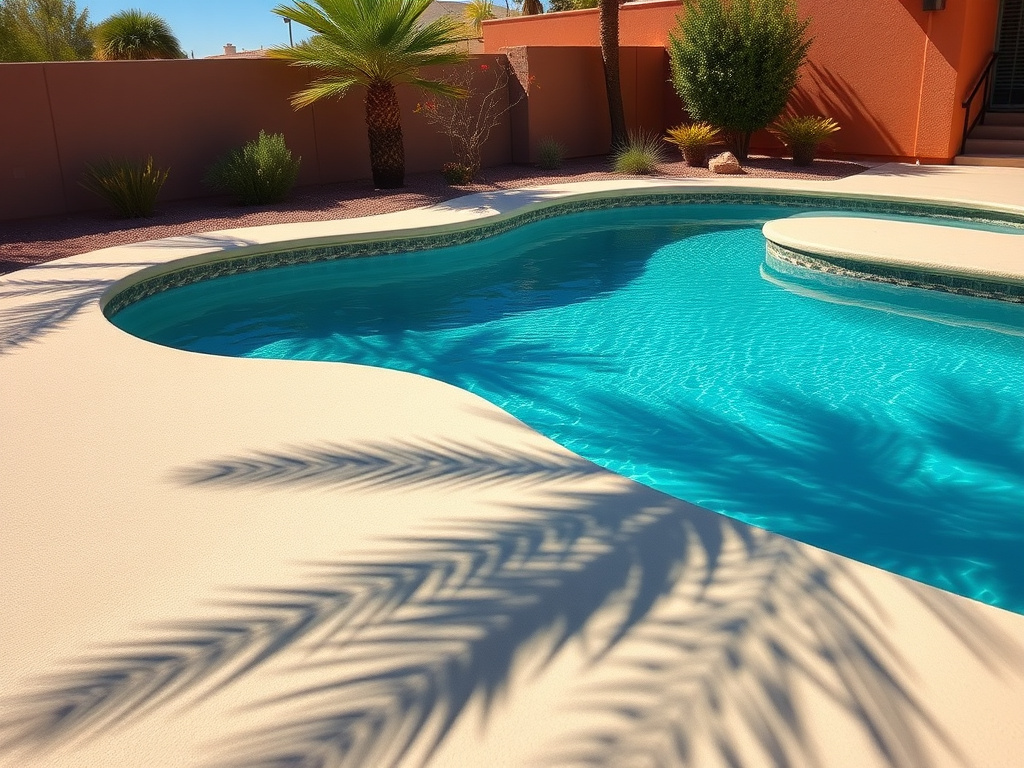
A pool deck in Scottsdale is the most punishing exterior slab most homeowners will ever own. It takes ten hours of direct ultraviolet a day for five months straight, it cycles from soaking wet to bone dry a dozen times an afternoon, it gets splashed with chlorinated or salt-chlorinated water, and it has to be comfortable enough to stand on barefoot at 4 p.m. in July. Very few surfaces do all of that. Most of the marketing around cool decking treats it as a single problem — temperature — when it is really three, and the three pull in different directions.
Surface temperature is about color and mass, not brand names
Surface temperature on a deck comes down to solar reflectance and thermal mass. A light surface reflects more of the spectrum and absorbs less; a textured surface has less contact area with the sole of your foot; and a thin coating over a thick concrete slab still has to fight the heat stored in the concrete underneath it.
Bare grey concrete in Phoenix or Chandler routinely reaches surface temperatures well above what a bare foot tolerates. A light-colored, textured coating meaningfully reduces that, and the reduction comes from three stacked effects: a higher-reflectance pigment, a broadcast texture that reduces contact area, and a film that is not itself a dark heat sink. What no coating can do is defeat physics — a light polyaspartic deck in direct afternoon sun is dramatically better than bare concrete and still warm. Anyone promising a cool deck at 115°F ambient is selling you something.
The practical implication is that color selection is a performance decision on a deck, not just an aesthetic one. We steer homeowners toward lighter blends on full-sun decks in Mesa, Gilbert and Tucson, and we will happily do a darker blend on a covered patio where it never matters.
Wet traction: the specification people forget
The single most common complaint about a resurfaced deck is not heat. It is that it got slick. A high-gloss sealer over smooth concrete is genuinely dangerous around water, and plenty of decks in the Valley are exactly that.
On a coating system, traction is engineered by broadcast: a graded aggregate or textured polymer is cast into the wet base coat and locked down by the topcoat. Grade the aggregate coarse and you get excellent wet grip that is hard on bare feet and hard to sweep. Grade it too fine and you get a comfortable deck that is slick when wet. The right answer is a middle profile, and it is chosen per deck based on slope, how much of it is shaded, whether there are steps, and whether small children use it.
Traction also degrades over time on the wrong system. Acrylic cool decks lose their texture as the raised knockdown pattern wears and chalks, which is why a five-year-old cool deck is usually both stained and slicker than it started. A broadcast texture locked under an elastomeric topcoat does not wear that way.
Chlorine, salt systems and what they actually attack
Two chemistries live on an Arizona deck. Traditional chlorine splash is an oxidizer that attacks organic films at the surface, chalking and dulling anything that is not chemically resistant. Salt-chlorine generator systems produce a different problem: sodium chloride solution wicks into porous concrete, crystallizes as it dries, and spalls the slab from inside. Anyone who has seen the white efflorescence bloom and the flaking at the coping on a salt-system pool has watched this happen.
A seamless elastomeric membrane addresses both. It has no joints or grout lines for solution to enter, it resists oxidizer attack far better than acrylic, and because it is a continuous film it keeps salt solution out of the slab rather than letting it cycle in and out. Pavers, by contrast, look great and have superb barefoot temperature but they have joints everywhere, and joints are where salt, weeds and settlement live.
The four options, side by side
| Cool deck (acrylic texture) | Cheapest per foot and genuinely lighter underfoot when new. Thin cementitious-acrylic film that chalks, stains, and cracks along any slab movement. Typically needs recoating every 3–5 years in the Valley. |
|---|---|
| Polyaspartic / polyurea with texture | Elastomeric, seamless, UV-stable, bridges hairline cracks, and takes a tunable broadcast texture. Higher up-front cost, no annual maintenance cycle, and it does not chalk off under sun. |
| Pavers | Excellent surface temperature and traction, and individually replaceable. But it is a demolition-and-rebuild project, joints move and grow weeds, and sand-set bases settle around Arizona soil movement. |
| Bare or sealed concrete | Hottest option by a wide margin and slick when wet with a smooth finish. Sealers add gloss and often reduce wet traction rather than improving it. |
General characteristics of common Arizona pool deck surfaces. Actual performance depends on slab condition, sun exposure and the specific product installed.
Resurfacing a deck that already has something on it
Most of the decks we quote are not bare. They have a fifteen-year-old acrylic cool deck that is chalking, cracked along every control joint, and stained at the drip line. The question is always whether it can be coated over.
Sometimes, but only after the same testing we do on a garage. If the existing texture is well bonded and passes an adhesion check, it can be ground down to a sound, flat plane and used as a substrate. If it delaminates in sheets when scored, or if it was installed over an unprofiled slab, it comes off entirely — and removal on a textured acrylic is slower than on a garage coating because the material is soft and loads up the diamonds. The approach is the same one described in why garage floor coatings peel in Arizona, and the underlying grinding and repair work is covered on our concrete preparation page.
Cracks deserve special mention on a deck. A pool deck is a thin slab poured around a heavy structure in soil that moves seasonally, so it cracks more than a garage does. A rigid surface telegraphs and re-cracks; an elastomeric one with real elongation bridges the movement. That is the same property that makes polyurea the right call in a garage, and it is explained in depth in the three-way materials guide.
How we spec an Arizona deck
- ✓Light, high-reflectance color blend on any deck with more than half-day direct sun
- ✓Broadcast texture graded for barefoot comfort and wet traction, chosen per deck rather than by default
- ✓Fully aliphatic topcoat — an aromatic topcoat will amber within a single Arizona summer
- ✓Seamless membrane carried into coping details and step nosings, with no joint for salt to enter
- ✓Elastomeric film build sized to bridge existing hairline cracking rather than telegraph it
- ✓Moisture testing on decks adjacent to irrigation, water features or a high water table
Timing matters too. Summer installs on an exterior deck start early and finish before the slab heats past the material’s application window, which is why we schedule Valley deck work at dawn in July and mid-morning in October. In Flagstaff and Prescott the calendar inverts entirely — we chase warm afternoons and shut down early. Our service areas page explains the elevation split.
If your deck is chalking, cracking or simply too hot to cross barefoot, the fastest path to a real answer is a walkthrough. Full system details live on the patio and pool deck coatings page, and you can request a scoped quote here.